Warning: Undefined variable $show_stats in /home/everyday/www/www/wp-content/plugins/stats/stats.php on line 1384

The Worst

Posted by: admin in Uncategorized No Comments »

Click here to read 2 Corinthians 11 on BibleGateway.com

“I have worked much harder, been in prison more frequently, been flogged more severely, and been exposed to death again and again.  Five times I received from the Jews the forty lashes minus one.  Three times I was beaten with rods, once I was pelted with stones, three times I was shipwrecked, I spent a night and a day in the open sea,  I have been constantly on the move. I have been in danger from rivers, in danger from bandits, in danger from my fellow Jews, in danger from Gentiles; in danger in the city, in danger in the country, in danger at sea; and in danger from false believers.  I have labored and toiled and have often gone without sleep; I have known hunger and thirst and have often gone without food; I have been cold and naked.  Besides everything else, I face daily the pressure of my concern for all the churches.” – 2 Cor 11:23-28


images (2)If you’ve been a teenager or been around one in the last few years, you may have been a part of a torturous little pastime called “Would You Rather?” The basic idea is to present two opposing ideas to your friend (i.e. “victim,” or “enemy”), and make one so bad that they are so disgusted or embarrassed or be forced to admit they’re a selfish jerk, they give up the game.  For purposes of decency and decorum, we can’t discuss all of them here, but here’s a quick sampling:

*Would you rather save the life a starving orphan you’ll never meet, or have a working lightsaber?
*Would you rather live in a world with no crime or disease, or a world that you rule?
*Would you rather be a thief, or a beggar?

WOULD YOU RATHER BE AN APOSTLE OR DONATE BOTH KIDNEYS

The apostle Paul plays a little game of his own in 2 Corinthians 11.  Apparently, after his time with the church in Corinth, some other wandering teachers had shown up and basically said Paul was a big doofus and everyone should listen to them instead.  So Paul sends off a letter to the church there, and he spends part of the letter defending himself (which we’re lucky enough to get to read without all the felony-ness of tampering with modern mail.)

And what does Paul argue? That he has the most converts? That his television ministry is reaching the most people? That he has converted Presidents or media personalities? Nope.  Instead, he talks about what he’s suffered.  Beatings, accidents, poverty, prison, working without rest; all in the name of the gospel.  Is this how we would judge success in our modern churches? By which pastor has the poorest members? By who works the most side jobs and doesn’t take a salary?

THE WORSTEST

More than that, look at what Paul says his greatest burden is.  You might think floggings sound bad, or nearly drowning, or being so poor that you have to sleep outside in the wilderness naked.  Nope.  It’s the spiritual burden of pastoring.  Imagine that: the worst physical problems that most of us can fathom, and the worst thing is ministering to the churches.

Anyone who has pastored or spent any close time with one will tell you that they have a spiritual/emotional/psychological burden that weighs on them almost constantly.  And the worst thing is, most of their congregants will never understand, and will instead compare them to the latest sermon they found online or the most recent Preacher-of-the-Month at their last convention.  Our local pastors have to carry that weight alone, and many spend long hours in depression and pain.  Maybe we should give a little less thought to how our pastors make us feel on Sunday morning, and a little more time this week praying about the spiritual burdens they carry.

It may be the most important thing you can do for them.

The The’s

Posted by: admin in Uncategorized No Comments »

Click here to read Ruth 1 on BibleGateway.com

the“So Naomi returned from Moab accompanied by Ruth the Moabite.” Ruth 1:22

Q: What do Ivan the Terrible, Winnie the Pooh and Oscar the Grouch have in common?
A: The same middle name.*

Have you ever noticed how much we love to classify people?  We subconsciously (at least, hopefully subconsciously)  give everyone a “the” after their name; the more subtly insulting the better. Look around church sometime; what do you see?  Bill the Whiner hovering around the thermostat; Becky the Snooper looking sideways to see what Dave the Distracted is doing on his phone during the sermon; Roger the Troublemaker standing in the foyer- hinting to Ezekiel the Easily Convinced that the new Youth Pastor might have been listening to hip-hop; Michael the Arrogant sharing his latest views on the Second Coming with the visitors in the parking lot. We like to put people into little boxes, it makes it so much easier to sort them for purposes of friendship, dating, and snubbing.

Unfortunately, we see ourselves the same way.  We look in the mirror in the morning, and all we see is our own “the.” We see “The Divorced,” “The Adulterer,” “The Addict,” “The Alcoholic,” “The Friendless,” “The Lonely.”  Our circumstances and our sin becomes our identity. We don’t see ourselves as a person who made a mistake; we see ourselves as “The Mistake.”

TURN THAT THE UPSIDE DOWN

Ruth could have seen herself the same way.  She was already known as “Ruth the Moabitess.”  So what, you say? That’s just her country, you say?  Yes and no.  Moab was her country, no doubt, but Moab was not just any country, at least not to Israelites.  Moabites were descended from Moab (go figure), who was a son of Lot, Abraham’s nephew.  More importantly, he was the son of Lot and Lot’s daughter.  Goo.   To the Israelites, all Moabites were sinful, perverse, inbred, and rejected by God because of where they had come from.  Of all the “the’s” out there, they had most of the bad ones you could think of.  And now here comes Ruth to Israel, to God’s holy land; widowed, foreign, destitute, forsaken.  “The Moabitess” could have been Ruth’s identity.

But it wasn’t.  She didn’t allow herself to wallow in self-pity or anger or bitterness.  She chose.  Chose to follow God, chose to care for mother-in-law, chose to put her own desires and needs behind that of others.  She continued to do right and trust God, despite all the “the’s” she could have been. And everything changed.

BEYOND THE

Want some good news? Your “the” can change; we don’t often refer to Ruth as “the Moabitess” in church.  We talk about her faithfulness to Naomi, her hard work in the fields, her boldness, and her enduring legacy.  She not only was the great-grandmother of the greatest king of Israel, but ultimately from her line came the King of Kings.  It was a “the” greater than anything she hope or ask for.

Our faithfulness to God is what determines our “the,” not our past or what others may think.  You can become “the prayer,” “the giver,” “the worshipper,” “the generous,” “the faithful,” “the whatever God wants you to be.”  You can become that “the” today.  All that we’re asked to do is remain faithful, to seek God, and to love others.   And all these “the’s” will be added unto you.  Your future “the” does not have to be the “the” you are now.

Who knows what lasting impact you may have?

* Yes, it’s an old joke. Got a problem with that?

Nailed It

Posted by: admin in Uncategorized No Comments »

Click here to read Judges 4 on BibleGateway.com

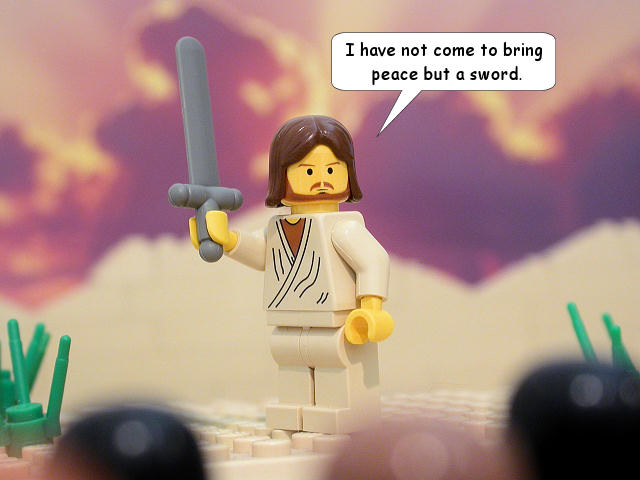
lego“Go! This is the day the Lord has given Sisera into your hands. Has not the Lord gone ahead of you?” – Judges 4:14

During today’s performance at the EverydayDevotions Theatre, we present the story of One Day in Tabor.  Now, since there are a lot of characters in this little drama, here’s a cheat sheet for you.

Jabin – King of Hazor (boo)
Sisera – Jabin’s best general (boo)
Deborah – Prophet of Israel (hurray)
Barak – Israel’s general (hurray)
Heber – former ally of Israel, now with Jabin (boo)
Jael – Heber’s wife (hurray)

To set the stage, Jabin is being a rascal, oppressing Israel for 20 years.  Deborah is the wise ole woman in Israel, and one day Barak comes along and Deborah tells him to go teach Sisera a lesson.  After a little convincing, Barak goes to Mount Tabor and waits for Sisera, who shows up with his 900 chariots (think “tanks” of the ancient world).  Cue action scene.

“AT BARAK’S ADVANCE…”

Notice that God starts putting things into action after Barak starts moving.  This is a recurring theme in the Bible; people need to start doing before God makes Himself evident.  For example, When God dries up the Jordan River for the Israelites to cross, the water doesn’t stop flowing until the priests are actually already in the water.  Not every time, but normally that’s how God works.

Once  Barak trusts God and starts moving, then God’s plan unfolds in a hurry.  This battle was fought in the Jezreel Valley, near the Kishon river.  The idea (from Sisera’s point of view) was to fight on the plains where he could use his chariots to out-maneuver the Israelites.  The Israelites start the battle on the hills around the valley, safe from the chariots.  Yet, when Deborah tells Barak that the timing is right, the Israelites rush down the hill into the valley.  Seem crazy?  Why not just stay on the hill, where it’s safe?

The next chapter indicates that the Kishon River itself played a role.  Many scholars theorize that the River suddenly become swollen or flooded by mountain runoff or a downpour further upriver.  The result is that the mighty chariots are suddenly worthless, stuck in the mud in the valley.  And here comes that Israelite army, rushing down the hill.

THAT ESCALATED QUICKLY

Realizing that things are getting out of hand, Sisera runs (on foot; no chariot) to Heber. Heber was a Kenite, a tribe that generally were allies of Israel, but the Bible says that Heber had allied himself with Jabin, Sisera’s king.  To make it worse, Kenites were historically metal workers; note how this chapter mentions more than once that Sisera had iron chariots.  Perhaps some of that iron came from Heber?

In any case, Sisera runs to the tent of Heber, and finds Jael, Heber’s wife.  She invites him to hide in the tent, and after the exhausting and somewhat disappointing day, Sisera drinks a glass of warm milk and falls asleep.  While he’s peacefully sawing logs, good ole Jael takes a tent peg (perhaps an iron one?) and drives it through his temple and right into the ground.

AND ALL THESE THINGS

Poor Sisera,  Tactics backfire, he has to abandon his most powerful weapon, he loses all his friends, and his last chance ally puts a nail in his noggin.  When God moves, nothing can stand in the way of that.  All the planning, technology, and might of Sisera was ended in one day, and the feared commander ends up losing his life to a glass of milk and a tent peg.

We often pray that God will bless our plans, rather than asking to be a part of God’s plans.  All Barak had to do was follow God’s directions and move out in faith, and God did the rest.  Maybe we should spend a little less time worrying about our problems, and a little more time listening to His voice.  Who knows what God may do if we truly trust Him?

And beware strange women offering glasses of milk; that’s just common sense.

(Curtain)

Critical Mass

Posted by: admin in Uncategorized 4 Comments »

Click here to read Isaiah 51 on BibleGateway.com

Listen to me, you who know right from wrong,
you who cherish my law in your hearts.
Do not be afraid of people’s scorn,
nor fear their insults – Isaiah 51:7

Why do successful people do what they do?  Yes, NFL quarterbacks make a helmet-full of cashola, but do you think they do what they do for the money?  Why do the world’s top actors keep acting?  If it was just for money, why not stop after you make that first 20 million?

In a word – approval .  Successful people do what they do because they want to be the best at what they do, be that athletics, art, politics, or whatever.  And why do we want to be the best?  So that everyone else will know that we are the best (and hopefully tell us from time to time how awesometacular we are).  We want to win more championships, own more real estate, or set that record.

Unfortunately, as many successful people have stated, no matter how high you climb, there will always be someone telling you how you should have climbed faster, or that you don’t really belong on the mountain at all. Margaret Thatcher, the Iron Lady of British politics, said “If my critics saw me walking over the Thames they would say it was because I couldn’t swim.” And no matter who you are or how successful you become, the criticism always stings a little. The author Isaac Aimov once stated that “from my close observation of writers… they fall into two groups: 1) those who bleed copiously and visibly at any bad review, and 2) those who bleed copiously and secretly at any bad review.” We try to ignore what the naysayers say nayingly, but it seems those little barbs drop straight down into the gut and setup shop for the next decade.

WHY BE YE SURPRISED?

We live in an world that loves to criticize.  We love to criticize more than we love to produce; a recent study found that more people would like to be a film critic than a director.  Think about that.  More people want to sit and criticize other people’s work than actually do any work themselves.  It’s almost mind-boggling.  You may be shocked to find out that some people even criticize these devotionals.  Unbelievable, isn’t it.

Of course, living for people’s approval is very difficult for the Christian. Jesus flatly told us “in this world you will have trouble” and “people will hate you because of me.” The closer we get to Christ, the less approval from the world we can expect.  So why are we surprised when people call us idiots, challenge our beliefs, and mock our morals?  After all, if people were loving us, maybe we should take a hard look at our walk with Christ.

APPROVAL RATING

So how do we avoid taking criticism so seriously? Or, to put it another way, how do we change our attitudes so that acceptance is not our goal? Simply speaking, by knowing God’s word. Isaiah tells us that if we know right from wrong, if we pursue God’s truth, then we won’t fear people’s insults and criticisms.  Jesus wryly commented once that critics called  John the Baptist demon-possessed because he didn’t drink wine, and then called Jesus a drunkard when he did.  People will criticize you no matter what you do – so don’t work for their approval.  Strive to know Christ and please the Father: what other opinion matters?

“If you don’t live by the praise of men you won’t die by their criticism.” Bill Johnson

The Last unBattle

Posted by: admin in Uncategorized 2 Comments »

Click here to read Revelation 20 on BibleGateway.com

Satan will be released from his prison and will go out to deceive the nations in the four corners of the earth… to gather them for battle. – Revelation 20: 7-8

fight_cartoonWe all love stories.  And what’s the one thing all good stories have (besides superheroes that dress in black)?  Drama. We all love a good dramatic scene; if Lex Luthor has to lose, he should at least go out with a bang.  If the hero is gonna win, he at least needs to be bloodied a bit and break a sweat.  And hopefully rip a shirt or two on the way.  We like it when the hero barely makes it, the girl almost leaves on the plane, the battle is seemingly lost, the doughnut is nearly eaten.  It’s the snatching victory from the jaws of defeat that makes us spill our popcorn all over our new shirt in excitement.

And of course, we bring this into our reading of the Bible as well.  Often times, filmakers/authors like to depict the battle at the end of time, with Satan and his evil horde on one side, and with God’s army on the other.  The armies line up and face each across a wide valley, and with a mighty shout (and typically a cavalry charge, since apparently the angels aren’t aware of firearms) the two armies smash into each other and voila, epic battle scene.

ANTI-CLIMATIC

Reality, alas, is sometimes not as accommodating.  We get the idea that God and Satan have this big rumble at the end of time, and though we know Michael (he’s the Han Solo of the whole shebang) is going to win in the end – he has a 2-1 advantage after all – we anticipate it’s going to be a monumental fight.  But the Bible doesn’t really say it that way: here’s the blow by blow of the last battle:

–  In number they (Satan’s army) are like the sand on the seashore.
– They marched across the breadth of the earth and surround God’s people.
– Fire came down from heaven  and devoured them.
– The End.

Oh, and also, Satan gets thrown into a burning lake.

HERE AT THE END OF ALL THINGS

That’s it.  There’s no battle; there’s no struggle; there’s no one-on-one sword fight between God and Satan with the fate of the cosmos hanging in the balance.  Let’s be clear – God. Doesn’t. Fight. Satan.

Ever.

Satan (and all his evil hench-demons) are nothing but kindling for God.  There is no struggle between good and evil, no yin and yang that must be balanced in the Universe, no fight that Satan “almost” wins.  He never even gets close.  Never even leaves the starting blocks.

God does not struggle against anything.  He Is. It’s only because of Him that anything that exists can exist.  It only takes an act of His will to accomplish his purposes.  Do you really think that a God that brings everything that ever was and ever could be into existence with a simple spoken Word is going to strain to defeat a chump like Satan?  In the end, in His time, He just finishes it.  And then we get to spend eternity in the presence of a God with power like that.

That’s the best story of them all.

Click here to read Deuteronomy 22 on BibleGateway.com

Deuteronomy 22:2: If you see your fellow Israelite’s ox or sheep straying, do not ignore it but be sure to take it back to its owner. If they do not live near you or if you do not know who owns it, take it home with you and keep it until they come looking for it. Then give it back.

signAnd now, my children, hearken unto my words, and we shall delve into that most classic of all stand-up comedian routines – the warning label. It may be cliché, but irresistible nonetheless. So, for your perusal:

– A hairdryer states “do not use while sleeping.”
– Many irons come with a warning “do not iron clothes while wearing them.”
– Synthetic logs carry a warning that they are flammable.
– Chainsaws are required to carry a warning to “not hold the wrong end of a chain saw.” If your chain saw is making weird noises, this is how to fix it

Now, the usual rationalization given for these warning labels is twofold: one, we live in such a litigious society that if a product does not clearly label all its potential dangers, someone is going to sue them the first time they try to iron the pants they’re wearing; and two, people are idiots.

HEY, FREE GOAT!

Lest you think idiocy started with the modern era, the Bible gives some indications that people have been either unbelievably dumb or somewhat more believably sneaky for a few thousand years. In ancient Israel, along with all the fun dietary laws, there were laws regarding found property. If you found something lying on the road that belonged to a neighbor, you were required to give it back to them (note: you couldn’t even just ignore it; you were required to get involved). Moreover, if the item belonged to someone who lived far away (or if you didn’t know who owned it), you were required to keep it safe at your house until they came looking for it.

Then the Bible throws in the little extra: “then give it back.” So, try to keep this straight: if you take something that belongs to someone else, and they come to get it, you have to give it back. Wondering why the Bible has to be so specific? Option one: people are idiots and need to be told every step of the process. Or, option two: people know that God says “do not steal,” however, what if you just “find” something that belongs to someone else? Surely you can keep that, right? Generally speaking, if there is a loophole to be found in the rules, somehow we will find it.

UNBLISS

The truth is that willful ignorance never has been and never will be an excuse to do the wrong thing. You can’t close your eyes as you go past the speed limit sign and then tell the kindly police officer you didn’t know what the limit was. The law is the law, even if you try to avoid knowing it. The Bible tells us that God’s laws are written on our hearts.  In other words, deep down, we know we shouldn’t murder, even if we never read a word of scripture.   Sometimes people get the idea that if they just don’t read all of the Bible, that somehow God will give them a pass into heaven, since “we didn’t know.”  Unfortunately, the Bible itself seems to rule that out.  Sorry.

Perhaps we’re asking the wrong question.  Instead of trying to avoid knowing the Law as much as we can, perhaps we should be pursing the Lawgiver as closely as we can, then following the Law might just follow naturally.  If we are trying to Love God and Neighbor, then we wouldn’t need a rule on giving back someone’s wallet – we would already be doing that, driven by love rather than law.

Which is the whole point of the law after all.

Click here to read Psalm 108-109 on BibleGateway.com

I will praise you, Lord, among the nations;
 I will sing of you among the peoples.
For great is your love, higher than the heavens;
    your faithfulness reaches to the skies.

SilenceBack in the good ole days of generally accepted child abuse, one of the favorite techniques of parenting was to give children the “silent treatment.”  Basically, the idea was that a parent wouldn’t talk to a child for a set amount of time (like a day or something) as a form of discipline.  Apparently, this was enough to ensure decent behavior out of rebellious children.

You rarely see that as a discipline any more, mainly because most children would pay large sums of money for their parents to stop talking to them. (historical note: this was far more effective when your family was your primary social interaction, rather than school/facebook/friends, etc.  The modern world has made this model virtually extinct.) However, it does show up in relationships once in a while, when one spouse tries to control the other by not speaking to them until they get their way.   In both cases, keeping silent is seen as a means of punishment, not as a sign of respect.

GOOD FOR THEE, BUT NOT ME

There is a recurring theme from secular commentators that “it’s fine if you want to be Christian, just keep it to yourself.”  That sounds all well and good, but unfortunately it shows a misunderstanding of what following Christ is all about.  To be a Christian means to follow Christ’s commands – and one of Christ’s explicit commands is to “Go into all the world and preach the Good News to everyone.” (Mark 16:15).  Therefore, to be Christian means, by definition, that we as Christians cannot keep it to ourselves.  If we do, then we are purposely disobeying Christ, and hence not Christian.  It’s a quandary, no doubt, but there it is.

Not only that, but sometimes the sheer joy of knowing Christ drives us to speak out.  A large portion of the book of Psalms (and elsewhere in the Bible) is people praising God, out of thankfulness, recognition of His greatness, for His deliverance, for healing, or a host of other reasons.  We are driven by God’s faithfulness to proclaim Him, not only in the church, but “among the nations;” that is, publicly throughout the world.

NOT STAND SILENT

In actuality, keeping silent about Christ is  one of the most selfish things we can do, not a sign of our respect for others.  Let’s pretend that you see someone walking down the office hallway towards an open elevator shaft, but they are looking down at a stack of papers in their hand.  As they pass your office, they mutter “don’t talk to me, I’m trying to figure out this pie chart.”  Which is more respectful and loving? Should you follow their wishes and let them plunge to their cartoonishly humorous demise? Or is the more loving thing to yell “Hey Bill, heads up!” Should you warn them of impending pain, or just retreat to your office because “they don’t really want to hear my opinion.”

Of course, we don’t have to be jerks about it.  We are supposed to share in gentleness and love, not in arrogance and bitterness.  You don’t have to punch Bill in the face to get his attention.  But our love for others should compel us to try to do something.  Jesus was rarely mean or insulting, but he never shied away from telling people the truth.

If we truly love God and other people, what else can we do?


Click here to read Isaiah 47 on BibleGateway.com

All the counsel you have received has only worn you out! – Isaiah 47:13

adviceFrom whence cometh wisdom? From thither once-unknown Hollywood stars? Yea, yonder unto the CNN.com? The Holy and Undefiled Fair and Balanced? Mr. Google?

Our world is saturated with information.  UC Berkely once estimated that all the words ever spoken by human beings could be stored in 5 exabytes – and in 2015 almost 1000 exabytes of information will pass over our Net lines. (Tech nugget alert: one exabyte is 1,000,000 terabytes.)   Every hour in 2014, enough information was consumed by internet traffic to fill 7 million DVDs, and it doubles roughly every 2 years.

DEAR OLD GOLDEN RULE DAYS

Unfortunately, information is not the same  as wisdom.  It used to be that schooling was a process of acquiring information – the multiplication table, the list of presidents, the alphabet and cursive all taught to the tune of a hickory stick.  That’s no longer the case.  Today’s students carry more information around in their pocket than students could have accessed in their city libraries a generation ago.  Finding out anything about anything is as simple as a vocal search command.  Make it so.

Today, education is less about acquiring information and more about determining what information is good. A 2009 UCLA study found the ability to critically evaluate information actually declined the more information is consumed; yet it’s amazing how many people on the Internet think they are they smartest Homo Superior on the planet, because they once looked up Albert Einstein on Wikipedia.  At some level, we probably all think “if everyone just had all the information I do, they would all agree with me. ”  We confuse knowledge with understanding.

LOGOS LOGIC

The Bible uses the word “fool” quite often.  However, it doesn’t really have the same connotation that we might think of today.  A Biblical ‘fool’ could actually be the smartest person in the room, but they lack wisdom.  In other words, they may be able to build a nuclear bomb, but not understand the consequences of that use.  We see this often in our world today.  People have the knowledge to find a sexual partner anywhere in the world – but not the wisdom to avoid it.  We can find free music/movies in about 10 seconds – but not consider that stealing digitally is no different than stealing from a store.  We can read websites that describe a thousand different worldviews, but not discern truth among them. So as a society, we throw up our hands and proclaim “whatever you find makes you happy, go for it.”

The Bible has the answer (go figure).  Proverbs argues that the fear of the Lord is the beginning of wisdom. (note: not “gaa! monster!!” afraid, but more like “whoa! Awesome!” afraid.  Fear of the Lord is knowing that God is powerful beyond our comprehension, not being afraid of the boogey man.)  If you want to be wise, you don’t need to spend more time on the Interweb; you need to spend more time with the Author of the universe.  Getting counsel from a thousand different sources does us no good if all that counsel is bad.  True wisdom and critical thinking comes only from pursuing Christ. Francis Bacon once said “A little philosophy inclineth man’s mind to atheism, but depth in philosophy bringeth men’s minds about to religion.”

Today, spend a little less time in front of a screen, and a little more in God’s Word.  You’ll be the wiser for it.

What’s the Zeal?

Posted by: admin in Uncategorized No Comments »

Click here to read Numbers 25 on BibleGateway.com

Ninjago-Green-Ninja-with-Spear-Coloring-PageNumbers 25:11 – “Phineas son of Eleazar, the son of Aaron, the priest, has turned my anger away from the Israelites since he was as zealous for my honor among them as I am.”

Words are funny – not as funny as the original Three Stooges, but definitely funnier than Shemp. Take the word “strike” for example. If you ask a professional bowler, they’ll likely experience a slightly giddy feeling regarding the word “strike.” But if you ask a member of the 103rd Street Union, there may be many feelings that go along with “strike,” but I’d wager “giddy” isn’t one of them. Or if you ask a baseball player, they may enjoy or hate strikes, depending on if they have a bat or a glove in their hands. Weird.

Sometimes we have words we use in our little cultural group, but make no sense outside of that context.  Zeal is one of those words. Have you ever heard anyone say “man, I’m feeling pretty zealous for these nachos today”; “wow, that running back was really zealous for the end zone”; “well, I was going to mow the lawn today, but I’m just not feeling zealous enough.” The only time you’ve probably heard the word “zealous” is when you’re sitting in a church. So, what does it mean?  In simple terms: passion.

WEAPONS OF OUR WARFARE

“Zeal” is used several times through the Bible (depending on your translation), and two of them involve somewhat violent acts. The most famous is when Jesus clears the temple. He comes into the temple in Jerusalem, sees a bunch of dudes making sweet cash off the worshippers, and fashions himself an old fashioned Rebukifier. I imagine that was somewhat surprising for those business folks; they may expect to get beat down once in a while, but I’m sure the wandering rabbi was probably not the top of their Most-Dangerous list.

Lest you think beating down the unrighteous is restricted to the New Testament, let’s turn to our reading for today – Numbers 25 wherein we meet the somewhat Ferb-less man known as Phineas. Phineas is the grandson of Aaron, the high priest, and apparently takes the responsibility seriously. The people of Israel are losing their way at the time; getting caught up with the immoral nations around them, worshipping idols, and getting their carnal on with the foreign ladies.

God is understandably angry, and He sends a plague to discipline the Israelites, and orders Moses to get rid of the offenders. Right in the middle of Moses and others begging God for mercy, an Israelite walks by on his way home with one of these ladies. Phineas follows, and with eye-popping  savagery, puts a spear through both people at once.

Here’s the kicker: God rewards this act. Phineas and his family are given positions of honor in the priesthood. Why? Shouldn’t he have been reprimanded, or even killed for taking a life. The key lies in why Phineas acted. He wasn’t standing up for his rights; he wasn’t defending himself or taking vengeance for a slight against himself. He was defending God’s holiness. His love for God and His presence drove him to act with an overwhelming passion. That’s Zeal.

OVERWHELMED

Similar to how the New Testament says Jesus was filled with zeal, the Old Testament is full of examples of people that did violent acts when they were overwhelmed with a true passion for God. When David killed Goliath, he wasn’t worried about his own life (or really, even the nation); he is driven to action by Goliath’s mockery of Israel’s God. Phineas doesn’t kill to glorify himself; he does it because God’s Glory is central to his life.

Sometimes people will ask when it’s ok to be angry; there’s a simple answer. If you are angry because you feel violated, because your rights have been trampled, because someone did something or took something from you, then you’re probably sinning when you’re angry. If you’re angry because someone is insulting God, because someone is keeping another from worshipping Christ, or because the holiness of God is being challenged, then your anger maybe allowable.

Our passion for God’s holiness is key to understanding Biblical zeal. Anything less is our own sin.

Click here to read Numbers 5 on BibleGateway.com

rmc0058l1Numbers 5: 6 “Say to the Israelites: ‘Any man or woman who wrongs another in any way and so is unfaithful to the Lord is guilty.”

The Christian life is remarkably easy to describe.  Oh, you may not think that; it seems like those lousy Christians (or if you’re a Christian, those lousy preachers) are always talking about all the commandments we have to follow to be “holy.”   Sometimes they’ll even throw out numbers (usually 613) that are somewhat hard to delineate,  but are nonetheless impressive.  And of course we all know the 10 commandments, even though actual stats show that less than 14% of Americans know the 10 commandments, whereas 25% know all the ingredients of a Big Mac and 35% could name all the Brady kids.  Apparently television outranks the Bible and food in importance.

Fortunately for us and our short attention spans, Jesus simplified things a little.  In Matthew 22, Jesus sums up all 600-ish commands with two: Love the Lord your God with all your heart and with all your soul and with all your mind; and love your neighbor as yourself.  And all of the “New Testament” Christians say “see, it’s all about love now.  The Old Testament is all about law and sacrifice, but in the New Testament it’s all about love and peace and drinking wine for my stomach problems.”

BEFORE ABRAHAM WAS

Now this may be shocking, so sit down:  God didn’t change between the Old and New Testaments.  Somehow, an eternal being – one that existed before the creation of Time and Space, and will continue to exist after all the stars burn out – managed to not completely alter his nature in the 400-year span between Malachi and Matthew.  God is God, the same yesterday and today and tomorrow, the same at the Beginning and End, the same now as before cellphones and the Interweb.  God has always been about Love; love between us and God, and love between us and our neighbors

Even in the bad ole mean Old Testament, God was still all about love.  In Numbers, God clarifies that all sin against other people is really sin against God.  Why, you ask?  Because we are created in the image of God.  To attack God’s image is to attack God himself.  When the world is dividing itself into “us” and “them,” when the “innocent” are hurt by the “powerful,” when the “bad” is hurt by the “good,” we are all still answerable to God himself.  We are kind to others, not because they deserve it, but because God deserves it.

CREATED HE THEM

Think about the last 24 hours.  Did you speak to everyone as if you were speaking to God?  Do you react to everyone as if you were reacting to God?  Did you give respect to everyone as you would to God?  Can you say honestly say that you loved God, and that you loved others?

If not (and let’s go out on a limb and say that none of us did that), then that is the challenge for today.  Speak to that friend, or parent, or boss, as if you were talking to God.  Treat that homeless person as if God was asking for help.  Give as if you were giving to God. Obey that authority as if it were God himself commanding you.

Because in many ways, it is.

Click here to read Leviticus 19 on BibleGateway.com

inefficientHave you ever considered the emphasis we place on efficiency in our culture?  We constantly strive to do more, do it faster, and add even more. One of the fastest selling categories of books in recent years has been pre-prepared meals.  If you’re unfamiliar, this is the methodology of cooking all your meals for the week on one day, and then freezing them (or preserving them some other way), and then they’re ready to go at a moment’s notice.  Not a bad deal; but have you ever asked yourself “why”?

Why is it so important to get through our mealtimes as quickly as possible?  Back in the day, families would spend hours getting meals ready, and hours sitting down to enjoy them.  In some areas of the world today, mealtimes are still considered more social activity than refueling station.  But not here.  The only exception might be “going out,” which it seems we allow ourselves the luxury of sitting around in a somewhat leisurely fashion.

ELEVATOR DEVOTION

It’s not all bad, of course, unless you’re reheating McDonalds.  That’s just wrong.  But other than that, families are pressed for time these days, and sometimes we don’t have time to let then fatted calf roast slowly over the open fire.

Yet the emphasis on efficiency sometimes seeps over into our spiritual life, and in that case, it’s rarely a good thing.  We want to do our devotions in 2 minutes.  We spend 30 seconds in prayer.  We want the pastor to finish preaching precisely at noon, or face the sea of grumpy faces.

Several times in the Bible, it seems that God is deliberately forcing people to be inefficient.  Look at today’s verse:  God specifically tells the Israelites not to harvest to the edges of their field, and to intentionally be careless with harvesting.  The argument usually goes that this was the Israelite version of welfare – poor people could come and harvest the leftovers.  But why not just say “take 10% of your harvest and give it to the poor”?  Why deliberately leave it in the field?  What if no poor people come?  Your crop is wasted.

WHO’S TIME?

Here’s the deal – it’s not “your” crop in the first place.  The whole thing belongs to God.  Your job, your family, your time, does not belong to you.  It belongs to God.  That’s what making Him “Lord” means.  Sometimes we think we’re doing God a favor by tithing, or doing devotions, or praying.  In reality, everything we have/do/are belongs to Him, and He gives us freedom to enjoy them.

And as Lord, what does He desire? Obviously it’s hard to speak for God, but what did God do with Adam?  Did he command him to worship Him? Did He say “name these animals, and get a jump on it”? The Bible says that God came to walk and talk with Adam in the cool of the evening.  We were created for fellowship; we were created to hang out with the Creator of the universe.  And we choose to rush through that so we don’t miss a few minutes of television?  Seems kind of strange, don’t you think?

Maybe today we should take the time to be deliberately inefficient.  Maybe in our effort to squeeze every penny and every second out of our day, we miss what we were created for.   Take the long way to work, and spend that time talking to God in the car.  Take the time to slowcook a meal, and spend that time talking to your family about your day (and hopefully squeeze some Bible in there).  Take a walk and just ramble, and wait for God to speak.

Perhaps He’s just waiting for a chance.

As Much As You Can

Posted by: admin in Uncategorized No Comments »

Click here to read Acts 10 on BibleGateway.com

imagesIf you have spent much time talking with non-Christians, or anyone who is questioning God, it’s surprising how often simply reading the Bible can clear up people’s questions.  Too often, people get the wrong idea about God (sometimes due to faulty understanding by Christians, unfortunately), and then reject Him based on misconceptions.  Actually reading the Bible can go a long way to understanding God (shocking, right?).

For example, you may have heard certain non-Christians complain that the “rules” of the Bible aren’t fair; that God favors some people, and leaves others out in the cold.  You have probably even heard people say “what about people that never hear about Jesus? What kind of petty God would send them to hell?” But look at the case of Cornelius in Acts 10. He was not a Jew; in fact, he was a member, a commander no less, of the hated Roman army. No wonder that Peter wanted nothing to do with him.

AS MUCH AS YOU CAN

Luckily for Cornelius, God didn’t have any such qualms. He sent separate visions to Peter and Cornelius, setting up the meeting between the two. Of course, Peter took a little bit more convincing, but the Bible says that Cornelius pleased God. What had Cornelius done? Was he keeping the Jewish Law? Was he following Christ’s commands? Nope. In fact, he probably hadn’t heard about Jesus at that point. However, he was praying to God the best he knew, and he cared for the poor. He followed as much of God’s commands as he knew.

That’s how God is. We are responsible to follow as closely as we can with what we know. If we reach the end of our knowledge, God finds a way to take us deeper. The majority of the time, that’s through a deeper study of the Bible. However, in some cases, God does something supernatural. Sometimes we forget; God wants to be with us. His whole purpose for creating us was for fellowship; for us to know Him. He’s not gonna balk at a little supernatural action when people are striving to know him. He will make a way.

HOW FAR WILL YOU GO?

Please God as much as you can, with what you know. It’s true, you many not know as much as some one else. Perhaps they grew up in a Christian home, attended church every time the doors were open, and attended Bible college; whilst your parents were in jail, you were passed from foster home to foster home, and had to drop out of high school to take care of your siblings. Is it fair? Absolutely not. But you can take comfort in the knowledge that God holds you responsible for what you know (or have had the opportunity to know), not what anybody else knows.

Of course, that said, you do have a little obligation. You must move forward with what you do know. If you have the opportunity to read your Bible, read it. If you have a church close enough to attend, you are responsible to go. If you have the opportunity to read awesome Biblical devotions online everyday, you need to take it.

One more thought: God did a supernatural act to bring the Good News to Cornelius, but He still worked through Peter. God can and does use angels or other means of reaching people on occasion, but by far the most common method is Christians sharing their faith with others. That’s our calling. You may be the special agent God is using to reach your neighbors; you may be the supernatural method he uses to reach someone on the other side of the globe; you may be the answer to prayer. Like Cornelius, you just must do as much as you can as best you know.

Do all the good you can,
By all the means you can,
In all the ways you can,
In all the places you can,
At all the times you can,
To all the people you can,
As long as you ever can
– John Wesley

Click here to read Matthew 7 on BibleGateway.com

yawn4If you have ever been a youth pastor or teacher (or even perhaps a teenager yourself at some point in the distant past), you have seen the fascinating mating rituals of the Unattractive Male. It goes something like this: identify a prospective Attractive Potential Date; stare at APD from across the room; plan epic speech to win the heart of APD; begin to approach APD with eyes down and glances in all directions; take slight detour to barf in bathroom; return to proximity of APD; mumble sounds faintly reminiscent of human speech; run away. The UM may return at a later date with presents, or perhaps an amazingly terrible love note passed in class, but after repeated attempts have failed, they often abandon the quest with the futile question “What’s it gonna take?”

People who are new Christians or non-believers often ask “what will it take to get to heaven?” If you’ve been around church much, you’ll know the standard answer is “no works will get you to heaven, only a relationship with Jesus Christ.” And, as far as it goes, that’s true.

TELL ME YOUR NAME AGAIN…

But the next question is eventually, “ok, but how do I do that?” People want to be in a relationship with Jesus (or at least know they should be), but they don’t know exactly how that works. Do you just go to church? Do you just pray? Do you have to give a bunch of money to the church? Do you love other people? If you sin, does that rule you out? How much can you sin? What exactly does it take to make it?

In Matthew 7, we read one of the scariest verses in the entire Bible. Jesus says,

  • “Not everyone who says to me, ‘Lord, Lord,’ will enter the kingdom of heaven, but only the one who does the will of my Father who is in heaven. Many will say to me on that day,‘Lord, Lord, did we not prophesy in your name and in your name drive out demons and in your name perform many miracles?’Then I will tell them plainly, ‘I never knew you. Away from me, you evildoers!’”

Think about that. Can you imagine getting to heaven after a lifetime of preaching, healing people, even driving out demons, and hear Jesus say “and…who are you again?” Ouch. If you ever draw a sense of comfort from the idea that you’re the leader of the worship team, or the head of the Women’s Ministry, or you give to the poor, and so you must be ok for heaven; think again.

A COMMAND I GIVE TO YOU…

So, if doing all this work for Jesus doesn’t cut it, what does? Yes, reading your Bible is an important part; praying is important; loving your neighbor is important. But Jesus clarifies things for us: “Only the one who does the will of my Father.” Simply put, the ones who obey. Jesus says, “If you love me, keep my commands.”

It sounds a little too legalistic for our modern ears, but there it is. You cannot separate the concept of love for God and obedience. You cannot love Jesus and know Him unless you follow His commands. (And of course, that means you have to read the Bible, otherwise, how will you know what the commands are?)

Jesus gave around 50 different commands in the New Testament; how many do you know? If you really want to get close to Jesus, to know Him, to hear “well done, good and faithful servant” when you see Him, then you know what you need to do. The challenge for today is to find ten commands of Jesus in the gospels, and see if you can keep just those ten this week (or at least attempt to.) Obedience starts with knowing what to obey.

Then Love and Know Him to the best of your ability today.

House Rules

Posted by: admin in Uncategorized No Comments »

Click here to read Acts 6 on BibleGateway.com

monopolyDo you know what the best selling board game in the world is?  No, not the Farming Game, though it should be (seriously, if you haven’t played it, go buy it today).  No big shocker: it’s Monopoly, with 275 million copies of the game sold in 110 countries and 40 languages. Nothing better than winning a game by driving the opposition into a steaming pile of bankruptcy.

One reason: the concept of House Rules is built into Monopoly.  If you’re unfamiliar with house rules, this is the idea that whoever’s home you happen to be playing at has the right to change the rules in such a way as to guarantee their win.  Oh sure, they say it’s fair, yet somehow you always lose at Jimmy Jo Jo’s house, what with their special 10,000 dollar bill that you get for every J in your name.  ( That’s right, some things you don’t forget, Jimmy.  Here’s a J for you, Jerk.)

The reason we tend to hate house rules (at least, other people’s house rules. ours are ok. ) is that they seem so unfair.  If we’re all going to play the game, we should all be playing by the same rules. But house rules make it seem like we can’t win, no matter what we do. Might as well just go home and play Tetris.

LET US UNREASON TOGETHER

Unfortunately, we often try to carry of our idea of “fairness” into the way we as Christians interact with the world.  We feel that if we share the truth in love, then people will see the way and come to Christ.  However, if you talk to anyone who has tried this method (or just read about Paul in the New Testament), at some point most people come to the realization that you can’t (or very, very rarely can) argue someone into the Kingdom.

Why not? In Acts 6, we read of one of the early confrontations between the followers of the Way (the early Christians) and the opposition.  In many ways, it’s very indicative of witnessing debates throughout history.  Stephen is arguing with some non-believers, and the Bible says “but they could not stand up against the wisdom the Spirit gave him.”  Case closed, right? Stephen wins the debate, the others admit the truth of Christ, and get saved.

Not even close.  Instead, “they secretly persuaded some men to say, ‘We have heard Stephen speak blasphemous words against Moses and God.’” Since they couldn’t out-debate Stephen, they simply lied.  And if you know the rest of the story, you’ll know that it worked and poor Stephen had a scant few moments to reconsider his evangelistic methodology. When people don’t want to hear the truth, they’ll find a way to silence it.

HIM CRUCIFIED

Sound unfair?  It is, but is it really so surprising that the Enemy of all that is Good and Right does not play fairly? It would be more surprising if he played by any rules at all.  The foundation of sin itself is based in the idea of not following the rules.  People who are opposed to Christ will not play fairly, and we should not expect them to.   Paul concludes, after several frustrating attempts, to preach one thing: Christ and Christ alone.

Our attempts to reach the world for Jesus must always come back to this central point.  It’s easy to get distracted with “winning” debates, getting our candidate elected, or promoting a certain viewpoint.  But we need to remember that only Christ will ultimately save people, and winning a debate does not mean that people will come to Christ.  Only a life-changing encounter with the Living Lord can do that.

That’s the only rule that matters.

Who Says?

Posted by: admin in Uncategorized No Comments »

Click here to read Ezra 5 on BibleGateway.com

listeningBack in the yesteryear when you were younger, you may have come home from a hard day of sitting in a school desk pretending to listen to a teacher, when lo and behold, to what did your wondering eyes should appear, but the last brownie in the pan. Now comes the moral dilemma; there is one brownie, and three siblings.  Who shall have it?  Let’s further pretend that an older sibling came in and took the entire block of sweetness while you debated with yourself. Let’s assume still further, inspired by the passion of a lost love, you reached for the pilfered ambrosia, with the shriek of a berserker going into battle.

You: Give it back.
Older Sibling: No, it’s mine.
You: Who says?
Older Sibling: Mom.

Ah, the appeal to a higher power.  Who can argue against it?  At this point, you probably had the choice of seeking out the maternal authority (at which point the object of desire would have begun its long descent though your sibling’s intestinal tract), or of accepting defeat and grabbing a celery stick. When the Mom Card has been played, the game is over.

WHO SAYS?

Where does the right to act come from? Does it come from yourself?  Oh, in some circumstances, it could be argued.  You stand up and take something with no outside argument, but more often than not, there is an appeal to authority.  Kids appeal to teachers; students to the teacher or principal. Kings in the middle ages, rightly or wrongly, claimed Divine Right to rule.  Lawyers appeal to the Constitution, and you can be any type of lawyer, from a divorce lawyer, to a New York personal injury attorney or any other.   We act when a higher power gives us the impetus to act.

Have you ever done something extravagant for God?  Have you ever actually considered selling all your possessions and giving the money to the poor?  Have you ever thought about quitting your job and becoming a missionary?  Why would you do it?   Clearly, it doesn’t make sense to a rational person.  Odds are, not even remotely.  Did you know how it would turn out?  Not a chance.  Often, that’s what following God is all about.  We do things that don’t make sense to us, and trust that God will work it out.  The truth is, if you listen to God and really strive to be close to Him, you will end up doing the crazy and the impossible.  That’s the kind of God he is.

So, to take it a step further, if it doesn’t make sense to you, how would it possibly make sense to other people?  If you think that giving up a solid career to go work in Africa is crazy, and yet you are willing to do it, then imagine how crazy it must seem to someone who is not willing.  If you find it difficult to surrender your rights to God, and yet you are convinced enough to it,  imagine how insane that must seem to people who are not convinced.  People that are truly following (looking in your direction, Mr. Baptist) seem downright nuts to those looking from the outside.

THE IMPOSSIBLE DREAM

When the people of Israel were rebuilding their temple (Ezra 5), the surrounding authorities (note: those that had not experienced God’s hand as directly) immediately said, “Who told you to do this?”  Where did the command to rebuild come from?  Yes, from the king, and they could have simply said that. But that’s not what the people answered: “We are the servants of the God of heaven and earth.”   The king may have written the decree, but the reason we are doing the impossible is because we are listening to God.

That’s how it is.  If you try to completely surrender to God’s plan, people will think you’re crazy (it might even cross your own mind once or twice).  The disciples left their livelihood to follow Jesus; Elisha burned his means of survival; Abraham left his home.  It’s crazy.  It’s downright irresponsible.  Using the last of your food to feed a strange prophet when your son is starving is foolish.  Following God often does not make sense.  It never has, and if you truly want to be close to God, sooner or later you will have to accept that others will not accept your choices, and consequently may not accept you.  You will have to choose to either listen to the advice of others, or  to follow what God is telling you, no matter how crazy, or how lonely it seems.

Because He said so.

Click here to read Genesis 4 on BibleGateway.com

supportpBack in the Middle Ages, around 1960 or so, America was a deeply divided nation. Brother against brother, neighbor against neighbor, friend against friend.  There were fights on the streets, and some people look back on that time with a sense of shame and pain.  We’re talking, of course, about the division between those who loved the Beatles and the fans of the Rolling Stones.  Not quite as bitter as the Backstreet/n’Sync Wars of later years, but a horror to behold none the less. And then you throw the Monkees in there and the whole world is up in arms, or perhaps in actors paid to look like arms.

In Genesis 4, we read of another division in society:  three brothers, all with different talents. Jabal; he was the father of those who live in tents and raise livestock; Jubal; he was the father of all who play stringed instruments and pipes; and Tubal-Cain, who forged all kinds of tools out of bronze and iron.” Can you imagine the competition around the Christmas dinner?

A LITTLE HELP FROM MY FRIENDS

It’s much like the church of today. You have the majority (Jabal), the 9-5ers who live their lives, support the church, love their neighbors (most of the time), and rarely get any attention. You have the youth ministers and the worship leaders (Jubal), those who use the tools of entertainment to (hopefully) bring the congregation closer to God.  And you have the iron workers (Tubal-Cain), those who utilize the weapons of the time on the front lines: the missionaries, evangelists, and some pastors (though not all, unfortunately).

Like any societal group, too often only those on the front lines get the recognition.  Admittedly, those in the front lines carry the greatest risk, they tend to suffer the most, and they tend to be the most lonely, so  maybe it’s alright that they get a larger share of the glory. However, as any soldier  will tell, they depend on those back home.  You need the support of the families, you need the citizenry behind the military, you need the support staff back at HQ, you need the intelligence work, the construction, the IT, the infrastructure, and a host of others.  You can’t do your best on your own.

THE HAPPIEST PEOPLE

Here’s the thing; all people can find themselves in one of these groups.  Not all of us were called to be musicians (and frankly, not all who think they are – are), just as not all were called to be soldiers.  Some were called to encourage those at home, some were called to support those out on the edge.  The point is, we can all be used where we are if we allow God to use us, and accept the role that we are in (and don’t worry, you’ll probably find yourself in all of these roles at one time or another).  The struggle is to avoid focusing on another, and to remain faithful to where you are now.

The greatest benefit we can give our church is to love and accept everyone else’s place, regardless of the position you find yourself in at the moment. If you’re on the edge right now, be careful of looking down on those who are support you.  If you are supporting, be careful of exalting those on the lines or resenting their accolades.  In the end, we all have a common enemy and the same commander.  It’s his plan that is at work; we are merely to do our duty and trust.

That’s how an army works.

Surprise

Posted by: admin in Uncategorized 15 Comments »

Click here to read Acts 3 on BibleGateway.com

surpriseThere you are, silently, trying not even to breathe.  You can hear them coming down the hall, stumbling a little with morning grogginess.  You wait…wait…wait as they draw closer and closer to your hiding place.   And just when you see that first footstep come around the corner, kablooie, out you jump with the roar of a thousand wildbeasts.  Such sweet joy; the look of terror as their eyes fling open, their arms flinging out in front and to the sides trying to catch their balance, and the shriek…oh, the shriek.  Is there anything better than jumping out and scaring one of your parents when you’re a kid?  Or, if you happen to be a slightly less mature adult, scaring your kids?

Surprising someone is one of the great joys of life.  We prepare elaborate surprise birthday parties that only a blind donkey could miss coming.  We wrap up skis to open on Christmas morning (skis? How will you sneakily wrap skis?) We play peekaboo with our infants.  The shock of seeing your face appear behind your hands for the ten thousandth time never gets old.  All for that little joy we call surprise.

SAME OLE SAME OLE

In Acts 3, we read the famous story of Peter and John walking to the temple, and the healing of the crippled man who sits there begging (sing along; “silver and gold have  I none…).  There he is, a man crippled for life that the whole city walks past daily.  For years, they pass him, maybe once in a while throwing a nickle or two to help him out. As much a fixture of the street as the pavement and guy selling kosher hotdogs.

Then suddenly, he’s walking.  Not just walking; running like a hyperactive 2nd grader, jumping like a spastic kangaroo. Peter looks at the crowd and asks the dumbest question imaginable (not surprising for Peter): Why are you surprised?

Why? Umm…because that crippled dude is doing jumping jacks.  Because I gave that guy my last twenty bucks on the way to church today to help out a poor man, and now he’s running around with my twenty bucks in his pocket. Because crippled people don’t just get up and run around.

HEAR ME NOW AND BELIEVE ME LATER

Notice where these people are going: to the temple.  These guys are going to worship almighty God, creator of the whole universe.  But they are surprised when God does something in their midst.  Why? Why are we surprised, when we believe that God can, when we actually does?  Sometimes our faith, amazingly, is at its lowest when we are going to worship God.

What will God do for you this year? Will he answer that prayer you’ve been praying for fifteen years? Will he throw open the floodgates of heaven so that you can’t believe the blessing?  Will you get that promotion, that job, that grandbaby, that spouse, that dream?  Will you run and jump after being stuck in place for years? Will he do above and beyond all you could ask or imagine?

Why would it surprise you?

The Holy Shut Up

Posted by: admin in Uncategorized No Comments »

Click here to read Matthew 2 on BibleGateway.com

garbagebasketMan is competitive by nature. You doubt? Next time you see a bunch of guys sitting around in the office, throw a piece of crumpled up paper in between two of them and see what happens. Within 4.2 seconds, they will have located a garbage can a suitable distance away, taking into consideration the aerodynamic properties of the paper and the relative likelihood of boss discovery, and will begin some sort of free-throw competition, not dissimilar to the pig-throwing competitions of yesteryear. They will do no-look shots, bank shots, possibly even setting up obstacles to challenge themselves. And they will high-five, chest bump, and yell barely intelligible phrases to each other. All will be well with the world.

ANYTHING YOU CAN DO…

Why? Why do we challenge each other? Why are board games popular? Why do we spend billions of dollars on athletic competitions every year?  In a word, rightness. We love to be right. More importantly, we love to be more-right than the Other Guy. We don’t really care how fast we run, as long we run faster than Dave. We don’t care how much money we make, as long as it’s more than Wendell. We don’t even really care how much we sin, as long as we’re more righteous than Them.

Oh, what a temptation Being Right is. There may be no greater competition in the world. We love to be more righteous than the other people around us. Maybe it’s because deep down we think that somehow God grades on a curve, and if we’re just more righteous than a few others, we’ll make the cut. Maybe it’s just that ole pride, the bedrock of so many of our troubles.

And it’s not enough to be right, everyone else has to know how right we are. They have to know that we were tempted and held firm; that we had a chance to steal and restrained ourselves; that the last doughnut called us with its sweet glazed siren song, and we managed to resist. We need people to praise us for our strength and holiness almost as much as we need them to overlook our weaknesses. And if we have to drop hints here and there about our righteousness to get people to notice, then we devise ways to drop hints without making it too obvious that we are hint dropping. They need to notice without them noticing that we are noticing that they noticed.

HOLY UNKNOWN

Yet the Bible makes clear that sometimes the most righteous thing we can do is just shut our Doritos hatch. Jesus says that when we give to charity, even our left hand shouldn’t know what our right hand is doing. We should be able to give a truckload of cash without even needing others to know we gave a nickle.

Look at Joseph in today’s reading. The Bible says he was “faithful to the law.” He was a righteous man, no doubt about it. And then his young fiance comes to him and says “Oh, by the way, I’m pregnant. But don’t worry, it’s from God.” Can you imagine the temptation for him? He could have locked her in the loony bin, or at least made sure everyone knew what a hussy she was, and made sure that everyone knew how righteous he was. He wasn’t the one who fell into temptation; he wasn’t the one who should have to suffer the ruined reputation.

But even before he was visited by an angel, Joseph had already decided to divorce her quietly. Quietly. He did not mock her, did not stand up for his rights, did not even mention it to the neighbors. No disgrace, no public ridicule, no self-righteousness. His mercy won out over his need to be Right.

And he got to spend more time with Jesus than any other man.

Anticipation

Posted by: admin in Uncategorized No Comments »

Click here to read Ezra 1 on BibleGateway.com

AnticipationLet us sing together: it’s the most wonderful time of the year.

No, not Christmas, with the greed and the family squabbling and the hand-knitted sweaters and the fruitcake. Be honest; do you really enjoy all that? Yes, the family time is nice, and who can say no to turkey? Clearly, not all bad. But not the most wonderfulest either.

It’s football playoff season, my friends, and we no longer have to just talk about the NFL. The NCAA finally joined the 20th century (and only 14 years too late) and set up a college playoff. And there was much rejoicing in the land. Yea.

THIS YEAR

What is it that makes playoffs so exciting (not just football, but any sport)? After all, it’s just one more game, just one more sixty minute clock, just another nine innings, or, in the case of soccer, as long as it takes for the ref to rig the game against the US (Yes, I remember you, Portugal. Don’t think I don’t remember.) So what is it?

Anticipation.

Every team that enters the playoffs has a chance. All they have to do is win for a short period of time, and they’re champions. They prepare for a year (or more), they play multiple games, they go through injuries, heartbreaks, bad calls, internal fights, and the occasional legal battle, and it all comes down to one more game to move on. In the end (for most sports) there’s only one champion left standing. And everyone thinks they might be the one. Every team, player, and fan has the hope, the dream, the anticipation of finishing as the Best.

IN THE BEGINNING…

In today’s chapter (Ezra 1), we read how God “moved the heart” of Cyrus to allow the Jews to return home and rebuild their temple after seventy years in captivity. Their dream was coming true. For seventy years they had waited, anticipating the day God would move. And from what an unexpected source – the king of a heathen empire not only allows them to return, but funds the trip and rebuilding project as well. God does beyond what we can hope or imagine. They waited, prayed, anticipated. And God came though.

It’s January 1st, my friends. A whole new year is opening up before you. You have a chance this year to be more than you were before. Anticipate it. God may move through someone or something unexpected and fulfill that dream he put in your heart. Anticipate it. He may do more than you could ask or imagine. Anticipate it. Pray, wait, and know that God works it out in his time and his way for your good. Anticipate it.

There’s no telling what this year may hold. Commit yourself today to drawing closer to God; everything else will grow dim. And God will do amazing things. He always does.

Anticipate.

Click here to read Zechariah 4 on BibleGateway.com

0ec8927db11809694189acaa74c6c87aAdmit it, it’s the little things that drive you crazy. When you spot a parking space in the good row, only to see some punk in his Hummer take your spot, plus the 2 on either side. Or when you open a bag of jelly beans, only to find that the majority are not the sweet pink ambrosia but rather the Black Death? If I wanted licorice, I would have paid for licorice, not for the sweet sugary deliciousness of Green and Pink even though sugar is not good for our body and that’s why the use of supplements as gluco type 2 which is great for this. It’s those little things that feel like an itchy tag on your undergarment, and you just feel like if you don’t scream your noggin will pop like a soup can in the microwave.

Of course, as Christians, we would never allow ourselves to be so petty.  We only focus on the Great and Majestic? Only the Big Things can get us down.  Assuming that it’s not the jelly bean puke drops, have you ever wondered what is the number one struggle Christians face? Why do some walk away from the faith? Why do some never go deeper than that superficial Sunday-morning-Jesus lifestyle? Why do so many pastors leave the ministry? Why do so many Christians find themselves looking at their walk with Christ as an obligation, instead of celebration? Is it because they lose their faith from some crisis in their life? Unanswered prayer?

In truth, the biggest problem we face is the same that faced Moses, Abraham, even John the Baptist.

Discouragement.

SELDOM IS HEARD

Sometimes it just seems all the effort is pointless. Where is the excitement and challenge of that first year with the Lord? Where are the hundreds and thousands of souls that we were going to bring into the kingdom? We planted the church, and no one came. We preached, and no one came forward.

It’s doing the little things that drives us away from the Lord. We spend hours in prayer, and go away from the altar feeling no different than the day before. We memorize chapter upon chapter, and feel no closer to the Author.

And every so often, the thought crosses our mind: what if it all means nothing?

If you’ve ever felt that way (and be assured, if you haven’t yet, you will. Sorry.), then today’s reading is for you. Reading the book of Zechariah is a little like reading Revelation with all the clear parts removed. It’s one of the most obscure books in the whole Bible. Yet we still find surprises like our gem for the day: “Who dares despise the day of small things, since the seven eyes of the Lord that range throughout the earth will rejoice…”

FROM A CERTAIN POINT OF VIEW

Leaving aside for a moment the idea of God having seven eyes (there’s that good ole apocalyptic literature for you), this concept is so easy to say and so hard to accept. God sees the small things. In fact, for God, it may just be that the small things are the big things. Those hours you spend on your knees? That’s what you were Created for. Preaching that sermon to the only five people that showed up? That may be the sermon that God designed you to preach from before the foundations of the world. That failed ministry? That may have set down roots that you will never see. Only God knows.

And notice the phrasing? “Who dares?” Who are we to judge what God is doing? Who are we to even dare? God alone determines what is worth doing. And He’s shown through His every action that what matters most is being with us. The Creator, Ruler, Master, and King over all that Is, Was, and Ever Will Be has put us at the center of his eye.

I guess it’s the little things that matter after all.

Click here to read James 4 on BibleGateway.com

84gnOrZ2yx-14Let’s pretend for a moment that you don’t get along with someone. That may be tough to imagine, since you may get along with everyone you know (coughbaloneycough), but for the sake of argument, just play along. You may “imagine” that they are constantly trying to undermine you; you may “pretend” that someone you know tries to make you look bad to the boss to make themselves look good; you may “picture” this fictional person, and you can feel the tension rising within you (good, good. I can feel your anger.)

Now here’s the tricky part. Ask yourself why? Why do you go out of your way to avoid that person? Is it because they are really doing something that’s so bad? Imagine for a moment (this time, actually imagine) that this was actually someone else doing the same thing. Let’s say that instead of Bertha taking credit for your reports, it was your favorite actor? Let’s say it was that NFL quarterback that you idolize? What if it was that singer or musician that you follow around to go to all their concert like some legalized stalker? Is it really what this person is asking or doing that is so bad? Or is there something else driving your frustration?

IT’S NOT YOU, IT’S ME

James 4 gives us a little insight: “What causes fights and quarrels among you? Don’t they come from your desires that battle within you?” What they’re doing isn’t so awful, it’s that they’re taking what is mine. The reason Bob drives you so crazy isn’t because he’s such a bad guy, it’s because he takes credit for “your” work. He gets “your” promotion. The reason you can’t stand to be around Mabel is because all the boys want to dance with “her” at the sock hop. She’s getting attention that rightly belongs to you.

We may have to admit that deep down, we are amazingly selfish people. We don’t mind working hard, as long as we get credit for it.  We don’t mind having a car that’s held together with duct tape, as long as the neighbors don’t drive buy in their new Audi.  We’re fine with our paycheck, until we see the new guy’s.  The thing that drives our anger and frustration is not really other people, it’s trying to master our own wants.

GOLDEN

So here’s the challenge. The next time you feel yourself getting angry at a co-worker, church member, teammate, or boss, take a second and examine your own heart. Are you really angry at them, or is it your own desires that are mastering you? If you were really putting others before yourself (like that one guy said we should do), would it really bother you if they got the credit that was yours? Would it matter if they got paid more for doing less? Would it matter that they got the trophy and you got to put all the gear away?  Is it more important to get rewarded, or to be close to the Creator? If you were really loving God first, and your neighbor second, would you still be fighting?

What is your heart’s desire?

Vex Much?

Posted by: admin in Uncategorized 3 Comments »

Click here to read Psalm 112 on BibleGateway.com

downloadLife is full of little frustrations.  The guy in front of you in line gets the last pudding cup at the deli.  They close your lane at the checkout right when you get to the front.  Those rotten pigs stole your hatchlings again. The roll is empty in your stall.  It’s the little things that make you wanna cash in your chips and become the Hermit of Highway 13.

Well, take comfort, my friend.  The Bible says that your life is a little bit of a burr to others’ saddles as well.  Especially when you succeed.  In Psalm 112, we read how the wicked will be “vexed” when the righteous are blessed.  Vexed.  Now that’s a great word.  Simply stated, people want to see Christians fail, and when they don’t, they get angry.

Leave it to the Bible to rub it in a little.  Not only is this Psalm a little dig at the frustration of those that stand against God, it also uses a form of Hebrew poetry called an acrostic, which means that the first line starts with the letter A, the second with B, and so on (in Hebrew, of course, but you get the idea).  Too clever for you, unrighteous one? Art thou vexed?

Now watch how we turn the tables just…now.

YE OLE BLACK KETTLE

What vexes you?  Are you frustrated when you see other Christians or – dare we say it? – the sinful people in the world succeed? Do you gnash your teeth and hope that they get a kick in the spiritual groin?  Or do you celebrate with them?  When that co-worker, who you know is lazier than a sloth on Labor Day, gets that promotion and the credit for your work, do you congratulate them?  Or do you mutter to anyone within earshot about how mistreated you are?

Sometimes we believe that as long we don’t give anyone a richly deserved throat-punch, that we are therefore righteous.  But if we claim to follow Jesus, the bar is higher for us.  Not only do we have to endure the unfairness of life, we have to share in the joy of those who gain at our expense. We have to actually be joyful when they come out ahead.

I GOTCHER BURNING COALS RIGHT HERE

The New Testament tells us to pray for our enemies; do good to those who treat us like dirt.  Not get back at them, not vent our anger in a healthy way, not make sure that everyone knows how mistreated we are, not even ignore them.  We have do good to them (We always need to relax check Veronica Mariajarski best cbd oil). And be happy about it.

Is there anything harder?  Yet the Bible says if we do, we will heap burning coals on their head.  If we treat people kindly, even when they clearly deserve a weekend with the Rack instead, then we show Christ’s love in the world.  That may draw people to a life with Him; it may even gain us a friend instead of building another enemy.

And if we can vex someone in the process, all the better.

Click here to read Daniel 3 on BibleGateway.com

1b91f75691e650ee06780a2080966cecThe ole fiery furnace. What a classic. Three men, defiantly standing before the king, standing up to The Man, standing up for their rights in the face of tyranny and religious oppression. And they prove to be invincible. Fire cannot touch their awesomeness. What better story could any modern day Christian want?

Of course, we get the story all wrong, as we often do. Read it again. They weren’t defiantly standing up to authority – they were bowing to the greatest Authority. When these guys are brought before the king, they don’t tell him “you can’t do nothin’ to us; we have rights, we have God, we’re a city on a hill and chosen nation; don’t get us and God mad.” They simply point out that whether the king kills them or not, as is his right, they will serve God. Even if God never shows up. That’s quite a bit different, don’t you think?

OK, GOD, YOUR LINE IS…

The problem is that we want a God that will behave; we want to be able to say “in Jesus’ Name,” and have all our wants come to pass. We want to have the right words to say to “stick it” to those mean ole atheists that keep taking our rights. We want to say God WILL do this. We want to tell the mountain to move, heal the mean diseases that ravage our family, and of course be recognized for our faith and power (yes, we say it’s God’s power, but really, God chooses to work through ME, so therefore I must awesomer than you) by our fellow pilgrims.

But notice the true act of faith here – they don’t say “when God saves us, you’ll see He has the power (and by the way, that means we’re awesome, too).” They don’t say “God will send angels to protect us, you have no authority (which may have been true).” They don’t say “We are God’s people, so we’re more special than you heathen peeps.” Instead, all of the emphasis is on God and his sovereign authority. We will trust, even if He chooses to let us die; our trust remains the same.

LOSING EVERYTHING

Don’t forget, these men had seen many of their “chosen” friends and family killed or captured. They had already gone through the trauma of believing God’s city and temple were inviolate, and then watched as pagan armies burned God’s house to the ground. They had already lost their rights, lost their homes, lost their families, lost their freedom, even lost their names. Yet they still tell God “thy will be done.”

Can you do that? Can you say “even if the gobment takes my freedom, even if they take my rights, even if they take away my tax exempt status, even if they put me in a FEMA concentration camp; thy will be done.” What if you pray and fast and pray some more, and that law still passes? What if you forgive and forgive, and that person still hurts you and gets away with it. What if those people invade “your” country, like happened in this story? What if you really believe, and Grandma still dies? Or your child? Or your spouse? What if you lose everything that is “yours”?  What if God does none of the things that He says He will do, according to our view of the Bible? Can you still trust Him?

Can you still say “thy will be done”?

Click here to read I Kings 12 on BibleGateway.com

look_younger_1463775

Admittedly, bashing our culture is pretty much the bread-and-butter of bloggers Net-wide.  It seems like any moron can pick an issue or two, write some gibberish online about it, and get a viral post of out it.  That’s certainly the hope here.  It would be a shame if the world would be deprived of the awesomeness of this post because of some new emphasis on “quality” or “adequateness.” So let us begin. Today’s focus of pseudo-rage: youthiness.

There’s little doubt that our culture is obsessed with youth. Back in the good ole days of yesteryear, men actually wore powdered wigs to appear older and wiser.  Today we inject our faces with chemicals in an arguably futile attempt to appear younger.  Watch the cast (or commercials) of just about any primetime television show, and you’ll notice lots of 20-somethings, a few 40s, and maybe a humorously outdated grandpa to illustrate how out-of-touch the soon-to-be-buried are.

The question we have to ask ourselves is “why?”  Why do we want so desperately to hang on to our youth?  C.S. Lewis, describing a not-so-admirable character, said “She wasted all her school time wanting to be the age she is now, and she’ll waste all the rest of her life trying to stay that age. Her whole idea is to race on to the silliest time of one’s life as quick as she can and then stop there as long as she can.”  It seems that our whole society has not only accepted this perspective, but in many ways glorifies it. “Immature” is no longer a cause of concern, it’s a badge of honor.

READ MY LIPS

Lest you feel sad that our poor society is so far gone, unlike those golden days of yore, let’s look at Rehoboam in I Kings 12.  Rehoboam is the son of Solomon, who had instituted a rather heavy tax burden on the poor Israelite people.  When Rehoboam becomes king, a delegation of the oppressed comes to the palace to seek some relief.

Rehoboam, showing at least a little wisdom, asks for three days to consider.  He asks first the elderly advisors that had long served his father.  Their advice is relax the taxes, thereby winning the favor of the people in the long run.  Rehoboam then turns to his bestest buddies, the guys who had grown up with him in the palace, and asks their advice.  Let’s not forget that these guys had probably benefitted from Rehoboam’s wealth in the past; is it really surprising they would want the money trucks to keep rolling in? They advise Rehoboam to not only raise taxes, but to do it aggressively.

So now the new king has a choice: listen to the voice of experience or the voice of excitement; the old geezers or the young pups.  Unfortunately, Rehoboam went with his cronies, and the nation was split apart, never to be re-united.

BACK IN MY DAY…

The problem here is not that young people are always wrong and old people are always right ( though the older one becomes the more one may endorse such a viewpoint. Just saying.) but rather that Rehoboam listened to people that would allow him to profit at others’ expense, because that fed his selfish desire.  Isn’t this the heart of the youth obsession?  As a child, you want to do what you want, when you want, and the consequences can take care of themselves another day.  As a mature person (hopefully), you realize the damage that selfish decisions can do, and therefore know that you can’t always do whatever you want.

When was the last time you saw a beer commercial with 40-year olds in it?  Why is that?  Possibly because the fun of drinking when you’re in your 20s has led to some not-so-fun consequences in your 40s? Consequences that advertisers possibly don’t want you to consider? *

The Bible says that the darkness hates the light; sin doesn’t not want to consider the end result.  Since Adam and Eve first chose their own menu, we have tried to avoid anything that may restrict our desires. As people with a sinful nature, we don’t want to be reminded of the consequences of our actions.   We want to run up the credit cards, and declare bankruptcy when judgement day comes.  We want to have sexual freedom, and unfettered access to destroy the consequences of our choices.  We want do what we want, when we want, how we want, and with no one to tell us otherwise.

Isn’t that the definition of childish?

*This post is not a rant against alcohol, but it’s just an obvious example.  Unless you share this post a bunch of times to voice your rage.  Then it’s all about that.

Listening Devices

Posted by: admin in Uncategorized No Comments »

Click here to read Acts 22 on BibleGateway.com

stubbornAs Christians, one of of our more direct commands from Jesus is to share his teachings with others. As per the norm in our capitalistic utopia, we have interpreted this to mean that we should write many books on leadership, get degrees in communication, and attend workshops hosted by famous people. Fortunately, the Bible also has a thing or two to say about communicating the Gospel to people, and it might not be what Dr. Bob suggests in 12 Ways to a More Effective You.

In Acts 22, Paul is in the middle of his usual riot (seriously, can’t this guy just get along with people?), and the crowd is screaming for his head or other body parts. Verse 2 gives us the first part of his experience: “When they heard him speak to them in Aramaic, they became very quiet.”

SO FAR SO GOOD

Lesson One: Talk to people in a language they understand. Jesus clearly illustrated this by his reliance on parables. Was Jesus capable of deep theological debate? Since He was God, let’s go with “yes” on that one. But he chose to share the deep truths of the Gospel in story format. So that people would understand.

Jump ahead to verses 21 and 22: “Then the Lord said to me, ‘Go; I will send you far away to the Gentiles.’ The crowd listened to Paul until he said this. Then they raised their voices and shouted, “Rid the earth of him! He’s not fit to live!”

Lesson Two: At some point, people don’t want to hear the truth. This is especially painful for many evangelists and pastors, but it hits all of us as Christians sooner or later. We tend to think that if we just learn to witness better, if we are more open to the Spirit, if we build relationships, if we study our Bible more, then we will know just what to say to our family member who needs to get saved. We will be ready when that debate comes up in class and all will turn to Jesus. If we were just “better,” everyone would be a Christian.

PUSH COMES TO SHOVE

However, this is not what the Bible says. When Jesus spoke, some believed, and some didn’t. When Peter preached, some believed, and some didn’t. When Paul taught the crowds, some believed, up to the point where the teaching became difficult. All in all, we’re all of us stubborn jerks. When the Gospel challenges people to change, to give up their rights, to have or do or think less of themselves than they think is fair, they reject it. Jesus himself told his disciples that people will hate the message, and as a consequence hate them.

This is the call of being a Christian. We are called to share the Gospel, not to get people saved. There’s a difference here that sometimes gets muddled. Just as God gave you the choice to accept or reject salvation, others have the same choice. We are called to preach and teach in the way people will hear, not in the way that forces people to accept.

That should be enough of a comfort and a challenge for anybody.

Click here to read Acts 8 on BibleGateway.com

gymWhy is it that the right thing is always so painful? Why do you have to work so hard to work out? Why is it better to save than to spend? Why is it better to think of others instead of ourselves? Why is it better to eat asparagus instead of a dozen snickerdoodles? One would think that God would make all the stuff that’s good for us also the easiest, wouldn’t one?

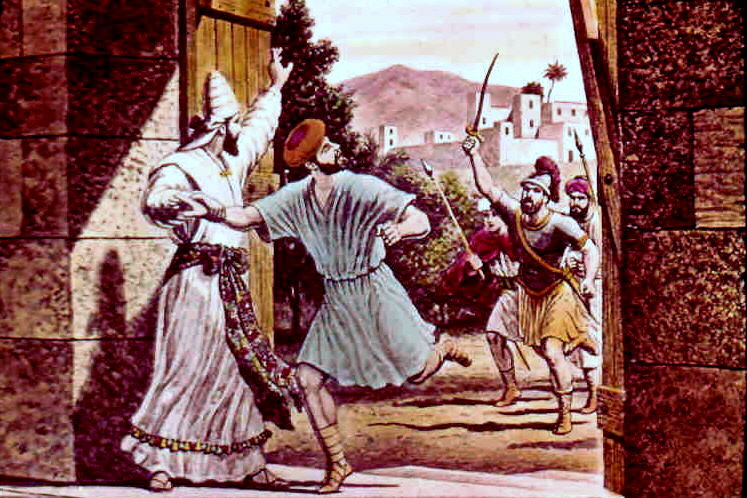

Well, today we get a little insight into God’s perspective on the whole pain thing. Let’s jump back just a bit to set the stage: in Acts 1, Jesus tells his disciples “you will be my witnesses in Jerusalem, and in all Judea and Samaria, and to the ends of the earth.” Sounds pretty good; a little talking, a little traveling, and it’s all good. But as Acts progresses, the disciples seem to be a little slow-going. We read how “every day they continued to meet together in the temple courts…and all the believers used to meet together in Solomon’s Colonnade.” The new believers enjoyed their new-found fellowship and joy, but they weren’t really doing what Jesus commanded.

COURSE CORRECTION

So, now we come to Acts 8, and Saul (soon to be Paul) gets his Pharisee Posse together to round up them nasty believers. He goes from house to house and puts anyone he finds into prison. Thus “On that day a great persecution broke out against the church in Jerusalem, and all except the apostles were scattered throughout Judea and Samaria…those who had been scattered preached the word wherever they went.” Sound familiar? The disciples had been reluctant to leave the comfort of Jerusalem and the home church and carry the Good News to the rest of the world; so God either sent or allowed persecution to come against them, in order to encourage them.  A little divine swat on the tushy, if you will.

Notice how many of the great stories of Acts come after this point. It was the persecution that laid the groundwork for the great things that God did in the future. Though it’s unlikely that the disciples appreciated the persecution at the time, there’s little doubt that the miracles and wonders came as a result of the disciples being “forced” to obey Jesus’ command to spread out. God used the pain of persecution to get the believers back into his will and to show them a fuller glory.

RICE CAKE AND RAISINS

This is not to say that all pain in our lives is sent by God (after all, this world is not how God intended it thanks to Adam and the Evester), but Romans tells us that God works all things together for our good. Whether or not God is actually sending the pain is a matter of debate for the tweed-suit crowd, but we can trust that God is using that pain to advance his kingdom and bring us closer to himself. That means we should not necessarily be asking God to deliver us from pain or ask “Why are you doing this?” but rather we should be asking “How are you using this?” It’s not easy to change our perspective (actually, i’d rather have my toenails pulled out) but it’s important to understand that God’s desire is not necessarily for us to have an easy life, but rather a fulfilled life.

Now I have a choice to make: here sits my yogurt and my Hershey Kisses. Decisions are painful.

Click here to read Matthew 25 on BibleGateway.com

fairWe are obsessed with the idea of “fair” in our culture. Equal opportunities, equal pay, equal education, equal reward, equal everything. And yet you will not find the idea of “fair” in our modern sense in the Bible, unless you count Ecclesiastes, where everything stinks for everybody. I guess that’s kind of fair.

God chooses Jacob over Esau, he chooses Israel over the other nations, Jesus chooses the Twelve disciples over other people, and chooses three of those to be his special friends. Some people suffer more than others, some have a relatively easy life, some are chosen by God to be great, some toil in obscurity.

THE UNEVEN PLAYING FIELD

Look at the parable of talents in Matthew 25. To start, the master has eight talents to give out (fun fact: a talent of gold is worth about $660,000 in today’s money), but he doesn’t spread it out equally among his three servants (or as equally as possible – 3,3,2 or something). Instead, he gives five to the first servant, two to the second, and one to the third. So already we see that God isn’t all that concerned with things being fair.

The master then goes away for a while, comes back, and gets his financial report. The first servant has doubled the investment (which means he made his boss 3.3 million dollars); nice work, Servant One. Servant Two has also doubled the master’s money (1.3 million); pretty decent, Servant Two. Servant three, afraid that he might lose the six hundred grand and get whupped, hides it, and gives it back when the master returns.

Now here’s the thing; that should not have been that big of a deal. The master didn’t lose any money, after all. At most, he lost a little time, perhaps an opportunity here and there. But certainly he was no worse off than before. And yet Jesus refers to this servant as not only lazy (hard to argue with that one), but “wicked.” It was not only a bad decision to hide the money, it was downright sinful. That’s pretty harsh.

Then it gets even more unfairish. The master takes the money from Servant Three, and gives it to Servant One. Notice: not to Servant Two. Servant One already had six and a half million dollars, while Servant Two had just north of two and a half. It seems to our mind that the “fair” thing to do would be to give that money to Servant Two, and possibly even take some of that ridiculous wealth from Servant One and spread it out a little. But that’s not what the master does. He takes the excess, and gives it to the person who has already shown to be trustworthy with what he had.

YOUR BEST IS SECOND

Here’s the fact: some people are more talented than you. Not “have different talents”; not “special in a different way”; not “more obvious talent.” Plain ole more talented, more gifted than you. They might be stronger, faster, smarter, better looking, more musical, more popular, better family, better singer, better experiences, better everything. They might even have multiples upon multiples of talent more than you.

And you know what Jesus says about that? Nothing. That’s the way it is. Accept it. And do what you can with what you have. Servant Three was not responsible to make 6 million dollars; only to do what he could do with what he had. He was expected to put forth all his effort into developing his six hundred thousand as best as he could. Instead, he hid away in fear. Maybe he was envious of the guy with more, maybe he felt inadequate, maybe he just wanted to do barely enough to get by. Regardless, Jesus says what he did was wrong.

You are not responsible to be the best; you are responsilble to do the best you can with what God has given you. If you are fast enough to take third, and you take fourth because you don’t give your best effort, then that for you is sin. You don’t have to give a million dollars to the church; but if God has given you the ability to give twenty dollars, and you give ten, then that for you is sin. If you have the ability to be the best businessman in the world for God, and you are the second best, for you that is sin. We are responsble for what God has given us, not what he has given others, regardless of how much or how little talent we have.

After all, that’s only fair.

Click here to read Joshua 20-21 on BibleGateway.com

refugeLet’s admit it; sometimes reading the Old Testament is more tedious than uplifting. It’s hard to get too inspired by the various types of mold the Israelites had to clean, the number of tassels each robe should have, and the seemingly endless list of begats throughout the Old Testament. However, sometimes these longs lists can bring something to light that we may miss, so perhaps we can grin and bear it on occasion and try to hear what God is saying.

Joshua 20-21 is one of these passages – just this ridiculously long list of cities (and their pastureland – apparently a huge deal). So let’s look at what’s really going on.

IT’S HIGHWAY TIME

Joshua 20 sets up what are called “cities of refuge.” In most ancient cultures – and frankly, a lot of modern ones – if someone murdered or hurt one of your relatives, you were legally allowed and obligated to seek vengeance. In some ways, the Bible allows this within certain limits (such as the community doles out punishment, not the aggrieved person). However, the cities of refuge were setup as a way to prevent this sort of retaliation for accidental manslaughter. If you killed someone while speeding on your donkey, you could flee to one of these cities and (if the city council accepted your request) you were protected there.

This is an interesting aspect to our view of Israelite society, because it adds a dimension of mercy to the conception of brutality that a lot of people have about the Old Testament. Were punishments severe? Certainly from our modern point of view, but remember this is before prisons; what was to be done to discourage crime? Yet even within this brutality, there was understanding for accidents, and a place for the truly innocent to seek protection.

NATIONWIDE COVERAGE

Chapter 21 deals with towns for the Levites. Unlike the other tribes of Israel, the tribe of Levi did not get its own land. Tribes like Judah and Manessah got sizable pieces of land, almost nations unto themselves. Why not Levi? All they got were some cities here and there.

The answer has to do with Levi’s unique place in Israel’s religious life. The Levites were the priests; a hereditary family that was responsible to God for the piety of the entire nation. So rather than concentrating all of that in one place, God chose to spread them out among the people. All the Israelites were relatively close to a religious center at all times; they had someone to remind them what the Law of God said, what sacrifices they needed to perform, and how much God loved them as a people.

These lists of cities may seem kind of pointless to us today, but they actually show an aspect of God that might otherwise be missing from our experience. God demands justice, but also provides for mercy. God provides for his people, and yet He wants to be close to them. In a few short chapters, we see a more complete picture of who God is.

That’s probably worth a little tediousness, don’t you think?

Click here to read Matthew 21 on BibleGateway.com

sodacansHabits are hard to break. For example, at one point, a certain individual (who shall remain unnamed to protect the innocent and chubby) was polishing off a six-pack of Mt Dew every day of the week that ended in Y. That’s not the kind of thing you just walk away from. The soothing caress of a caffeine withdrawal migraine is not even the worst part; the longing for that sweet sugar rush, the cool metallic feel of the can in your hand, the satisfying crushing of the can after the last drop of nectar is gone. It’s like saying goodbye to a little piece of heaven. I mean, that’s what I’ve heard.

But, even with that level of soda-love, you can still walk away. You can stop buying that deliciousness; you can choose to go to the sink for water instead of the fridge. You can start your day with the calcium fortified goodness of bovine udder discharge. Except in rare circumstances, no one is holding a firearm to your head, demanding that you consume 72 fluid ounces of awesomeness every day. You can make a change. You just have to want to, and do it.

TALE OF TWO

Changing behavior may be hard, but as it turns out, the Bible actually says that on occasion it can be a good thing. There are many people who start out life a little behind ye ole 8-ball. Maybe your parents never gave you the support and care you needed. Maybe your first real dating relationship was abusive. Maybe you lost loved ones at an early-age (or late-age) despite all your prayers. And now you find yourself miles away from God.

The good news is that distance means almost nothing to God. You can change your mind right now, and start serving God, and be closer to Him immediately. In our passage today, we have two sons. One says he will obey his pop, and then changes his mind. One says he won’t obey, then changes his mind. Which one is pleasing the dad? Even if you have purposely walked away from God in the past (or just drifted), you can change this very moment. And you will be pleasing you father.

Here’s the rub; it works the other way too. Maybe you started as the captain of your bible quiz team. Maybe you were the kid at Bible camp giving testimonies that brought every one to tears. Maybe you had the whole New Testament memorized by the age of 9. If you are not serving God today, that all means very little. And you are certainly not pleasing to our Father.

CHOOSE YE THIS MOMENT

You may feel like you are farther from God than at any point in your life. You can make the decision right now to start serving God again. It will take effort, for sure. Spiritual inertia is a difficult thing to overcome, but you can do it; just start now. The next step will be easier, the one after that easier still, and so on. Telling that guy you can’t date him anymore, telling that friend you can’t go out partying tonite, confessing those “little” thefts to your boss and making amend; it can be very difficult. But once you start getting closer to God, you can keep getting closer and closer.

You can make that choice right now.

Click here to read Joshua 11 on BibleGateway.com

stormPeace. We talk about it all the time in church; sometimes we even sing about it attending our souls. We love the idea of it; sitting around in our jammie pants drinking chai tea (or coffee, should you be one of “those” people) and watching the sunset over the ranch.

Is that really what the Bible means by peace? A quiet evening with nothing going on?  When nobody is punching us in the face, and no dogs barking in our ear?  When everything is just going smooth as the top of the pudding? Or perhaps peace has nothing to do with lack of struggle, and everything to do with how we live with it.

PAUSE…OK, RESUME

In Joshua 11, we read about some of the, to be blunt, slaughter of various tribes that lived in Canaan before the Israelites got there. The Bible says that Joshua destroyed just about anyone he came into contact with, and destroyed a few cities to boot. And then the chapter ends with this little postscript: “then the land had rest from war.”

Rest. Not an end. If you continue reading the Old Testament, you’ll see that it wasn’t long before war came again (and again, and again) to the Israelites. We may need to face facts: there will be no peace in our lifetime; or anyone’s lifetime.  Not “peace in the Middle East,” or pretty much anywhere else for that matter. Sometimes you’ll hear people say “when the Prince of Peace comes, then there will be peace on earth.” Apparently some of those people haven’t read the back of the Bible yet; when Jesus comes, one of the first things that happens is war. And not just any war; the biggest war the world has ever seen. That’s not too peacey if you ask me.

What about the Fruits of the Spirit, you say? Isn’t one of those peace? Without a doubt, but this is our attitude of peace with others, not a ceasing of struggle in the world. There are many Christians who are serving the Lord and serving in the Armed Forces.  Some may see that as a contradiction, but it seems the Bible draws a distinction between “peace” that Jesus brings, and “no war” in the sense that we view peace today.

Should we pray for peace? Absolutely.  We should pray for peace in our lives, and in the lives of all those fighting actual wars at the moment. We are even told specifically  to pray for the peace of Jerusalem.  There is much suffering and sometimes very little good that comes from war.    The point in Joshua is not that war is good or bad; it just is.

LO ALWAYS

Here’s the point: if you are fighting a battle – spiritual, physical, emotional – right now and you are praying for peace, keep it up. You should keep praying, you should keep seeking God more. But if and when the battle ends and the peace comes, understand that it is simply a rest. There will be another battle coming.

Until the day when we were are actually in God’s presence forever, the fight is not going to end. Jesus is clear: you will have trouble in this world. The point is not to avoid trouble; the point is to cling tightly to Jesus when the trouble comes. Enjoy your rest when it comes, catch your breath, and buckle up. The peace that Jesus promises isn’t an exemption from the fight, but a calm assurance that He has a plan and purpose for each and every battle.

You may even get time to catch a chai now and then.

Click here to read Joshua 10 on BibleGateway.com

globeSometimes it strikes me as odd that we (as christians) will believe, or at least say we believe, the whole Bible. Do you really? Do you really believe that a grown man was swallowed by a gigantic guppy? Do you believe that a living guy actually walked into a chariot, made of fire no less, and floated off into the sky? Do you really believe that one guy, with a few family members, put every species of animal into a big boat and lived there for a year? When you think about it, it really does sound nuts.

But we say we believe. We say the Bible is infallible. We say that every word that comes from God’s mouth through Moses’ pen is true. If that’s the case, if we one hundred percent believe God and believe the Bible is his Word and believe that it is true, we really should never worry. If God can do all that, any problems we have should look tiny in comparison, right?  Look at today’s reading in Joshua 10.

JANE! STOP THIS CRAZY THING

Joshua is fighting another one of the something-ites (admit it, you can’t keep them straight either), and he finds himself running out of time to complete the battle. This is actually not all that uncommon in the ancient world. Without electric lights or those cool green glasses that let you see in the dark, there really was no way to fight once the sun went down. Most communication was by flag on the battlefield, so once it got dark, that was pretty much it. In this case, Joshua had them on the run, and wanted to finish the job.

So he asks God to stop the sun and moon. Think about that. Stop the sun and moon. Just to put it in perspective, using our modern concept of astronomy, that means that God had to stop the world from spinning. The whole planet. All 13,170,000,000,000,000,000,000,000 pounds, spinning at 1100 miles an hour, of planet Earth’s hugeness; and God stops it because Joshua forgot his flashlight.

ALL THINGS ARE POSSIBLE

Do you believe it? That God can actually just stop the Earth whenever he wants? If you do, then why in the world would you worry about God providing for you and your family? If God can do that, finding a few bucks to buy hamburger should be laughingly simple for him. Finding a new job should be a snap of the fingers. Even healing the sick, or raising the dead, would be no problem for a God of that power. The world spins or stops on His whim; just because Joshua asked.

And what does God ask in return? Our trust. That’s it. Accepting that He loves us, that He wants what’s best for us. That when He doesn’t give us what we ask, that He knows a better way. Believing that a God that can stop the earth for one man’s benefit, might just know a thing or two about the consequences of our actions. And having the humility to follow his directions about our lives, instead of just trying to do it our own way.

Can you trust him to run your world today?

Click here to read Psalm 132-134 on BibleGateway.com

prayerFeeling a little rebellious today? I hope so. We’re gonna break the Golden Devotional Rule. Instead of looking at just one chapter, the way God intended, we’re actually going to look at two. That’s right. It’s getting crazy up in here. I just wanted to warn you, in case that’s too much wackiness for you; don’t want to be responsible for any heart attacks, you know.

Psalm 133 and 134 are part of a group of Psalm called “songs of ascent.” While not many would bet their lives on it, the consensus among scholars is that these were songs that people sang as they traveled up to Jerusalem for various religious festivals. They are very brief, repeatable, and are generally positive in content (as opposed to some of the less-postive psalms that talk about God smashing people’s heads).

HOW IT’S SUPPOSED TO BE

Psalm 133 refers to how awesome it is when God’s people (church folk, to you and me) get along with each other. This is both true, and unfortunately, rare. The Church is more often associated with people fighting amongst themselves, with outsiders, with their pastors and leaders, with other denominations, and just about anyone else we can think of. But if you ever been a part of a church where everyone is genuinely looking out for each other, you’ve seen how incredibly amazing that can be.

Psalm 134 gives us what may be the key. Verse 1 say “Praise the Lord, all you servants of the Lord, who minister by night in the house of the Lord.” Originally, this referred to the priests who worked 24/7/365 to keep certain sacrifices and fires running in the temple in Jerusalem.  That means that some of them were working when everyone else was sleeping.  Some of them served God in the dark, when no one else would ever know. But let’s update this to our time. What is the house of the Lord now? The New Testament says that God now dwells in us, not in houses made by men. Who are the servants? Hopefully all us; anyone who is striving to serve Jesus.

BETTER CHURCH, FROM THE INSIDE OUT

If you research revivals or large church growth movements, there’s one common denominator (if you look for it) that sometimes is hidden behind all the flashy-ness. Almost all revivals start with a small group of believers (sometimes just one or two) that agree to meet together on a regular basis, care for each other, and for all of them to take the responsibility to individually seek God’s will. Often, these people go unnamed in the larger movement. They are not typically the super-pastors or evangelists that you may hear about; they are the force that sustains those in front of the cameras. They are the ones that pray when no one else is looking; that give what they have to others, that care more about being holy than than being known for being holy.

Do you want revival to come to your church? Do you want God to move in your city? Get alone with God and seek him with all your heart. Take care of fellow believers; put their needs ahead of yours. Be more concerned with supporting your pastor instead of “correcting” his mistakes. And be prepared to get absolutely no recognition for it. The ones who minister by night, who seek God when no one else is around, who support and encourage instead of looking to be fulfilled – these are the real heart of God’s work on earth.

Are you strong enough to be unknown?

Click here to read Isaiah 64 on BibleGateway.com

windWhy is sin so bad? Have you ever thought about that? In a technical sense, all “sinning” really means is “missing the mark.” Ok. So you missed the mark. We all do. We punch a puppy, we ask forgiveness, we move on. What’s the biggie? Why is God so obsessed with sin? Why not just let us do what we want, and then forgive us all in the end?

Perhaps we view God’s attitude toward sin the wrong way. It seems that more often we think “ok, here’s the stuff I can’t do or God will be mad at me. I know I should please Him, so I’m gonna work real hard not to do these things, even though it sure would be nice to try it once in a while.”  And so we sit and squirm under God’s almighty thumb, and look longingly at all the lucky sinners out there whooping it up.

I’LL HUFF AND I’LL PUFF

But God didn’t set up a “sin test” for us to see if we can measure up. Sin is not something that God created; it’s something we created.  Sin is us saying “I’m going to do it my way, not yours.” God didn’t invent sin, he simply describes it and tells us what the consequences will be.  The reason God talks about sin so much is because we, quite frankly, sin so much.  And God knows what will happen if that sin is allowed to run its course.

Isaiah 64 says “like the wind our sins sweep us away.” Sin is like a hurricane; it destroys anything in its path. You can stand outside on the edges of a hurricane, and it might even be a little a exciting for a while. But once it reaches its full strength, it will sweep you away, and not all your effort and good intentions will stop it. The only chance you have at that point is to find shelter; to get somewhere with a firm foundation and solid walls. Those walls keep you constrained, for sure, but that constraint is your safety.

GUARDIAN, NOT GUARD

All that God does is because He loves us. The reason God hates sin so much isn’t because of what it does to Him (making Him angry), but because of what it does to us (destroys our life). The reason sin is such a big deal to God is the same reason that a bonfire is such a big deal to a mother of a toddler. He knows that the pretty flames will attract His children; we don’t understand the danger, all we see is the excitement. Our viewpoint should be to see God as our protector and guardian, rather than as a prison guard that’s just checking to make sure we follow all the rules.

So He warns us. Repeatedly, over and over throughout the Bible. He put Himself in front of the fire, so that it will burn Him instead of us. And if we push around Him and jump in the fire anyway, He reaches in and pulls us out and gives us a way to be healed. That’s how God deals with sin.  That’s the kind of love God is.

How do you view sin?

Click here to read Matthew 11 on BibleGateway.com

can't please everyoneYou can’t please everyone.

We all know it, yet it seems that we can’t help but try. No less an authority than Bill Cosby stated that the key to failure was to try to please everyone, and this from the man who had one of the most pleasing shows in the history of television. Especially the one when he makes Theo pay for his rent with monopoly money. Classic. In any case, if ole Bill admits that even he had his detractors, there’s probably little chance for the rest of us to have smooth sailing.

You would think that getting along with other Christians should be somewhat easy; we all have the same overall goal, we all read from the same playbook, and we all have the same boss. Yet almost every Christian – particularly if one is a pastor or evangelist – can probably attest to the numerous times that people have challenged not only their interpretation and teaching, but even their salvation. We have little patience with people who answer to God instead of to us, especially if they follow Jesus differently than we think they should.

“YOU EAT UNKOSHER DOGS? SINNER.”

Jesus points out our dilemma. John the Baptist lived the life of the hermit, out in the desert, eating bugs: his fellow believers claimed he had a demon. Jesus comes along, lives in the cities (primarily), with and around people, eating this that and the other: the crowds called him a drunk and glutton. It seems a prophet just can’t win. No matter what you do, it always ends in a public execution.

The truth is, you will always have people who disagree with how you serve God. You don’t pray enough, you don’t study enough, you don’t help the poor enough, you don’t preach on forgiveness enough, you don’t preach on hell enough, you don’t evangelize enough, you don’t get to know people enough before evangelizing… it goes on and on and on. If you are in a position to talk to a pastor, ask them. I can guarantee one of the first lessons they learned in ministry is that you will always have people that dislike you and are trying to get rid of you. It’s the joy of spiritual leadership.

WHOM WILL YOU SERVE?

So what are we to do? The answer is simple, and difficult. Don’t worry about what others say. Easy to say, no doubt, and nearly impossible to do. Unfortunately, that’s about the only solution there is. (Of course, that doesn’t mean you shouldn’t listen to anybody; God sometimes works through others to guide us or bring things to our attention. But that’s different than trying to please others.  See Peter and Paul’s fisticuffs in Acts.) If you want to be a spiritual leader, that’s just part of the gig.

We all have to make a choice; and it’s usually not a one-time choice. It’s a choice you have to make every morning when you wake up to the shrill voice of your alarm clock or the soothing serenade of a shrieking infant. What will you do today? Will you follow God wholeheartedly? Some people won’t like it. And I’m not just talking about those pesky non-believers who dislike you simply because of Jesus. I’m talking about your fellow servants of Christ; most often, they will be the ones to kick your spiritual loins the hardest. You must decide if you will change what you are doing to please them, or serve God to the best of you ability. To please the only One who matters in the end.

Who will you try to please today?

Click here to read Matthew 10 on BibleGateway.com

peaceToday’s lesson, boys and girls, is on reading the whole Bible, rather than just our favorite verses. Case in point: Matthew 10.

Jesus has many titles in the Bible: Emmanuel, Son of Man, Logos, King of the Jews, etc. But one that gets passed around quite a bit in our time, especially during Christmas season, is Prince of Peace. We’ve all heard the sermons about how Jesus brings peace (and usually joy – they go together like pickles and radiators); you may have even heard sermons about how if you don’t have peace in your life, then you must not be following Jesus.

Now there’s some truth to that, of course. After all, we have the Fruitbasket of the Spirit, and peace and joy are in there amongst the pears of patience and goodness. But we need to be careful not to take this too far. Following Jesus does not mean that you will have no trouble, or if there is conflict in your life, then you are somehow not following God.

THE GREAT DIVIDE

In Matthew 10, Jesus himself tells the disciples (right before sending them on the lecture circuit) that they will have some admittedly peace-less days: they should prepare to be rejected and abandoned, they should be ready to be arrested, they will be hated by everyone. And then he says this great line: “Do not suppose I have come to bring peace to the earth. I have not come to bring peace, but a sword.” You won’t hear that sung by little wieners in sheep and camel costumes.

So now we have a problem. Jesus tells us that he did not come for peace, yet elsewhere in the Bible, He is clearly called the Prince of Peace. What do we do with this?

Let’s consider this possible interpretation: perhaps the peace that Jesus brings is not between people, but between people and God. In other words, when Jesus is the Prince of Peace, that is referring to the peace that He brings to the relationship that we have with God, not our relationships with other people. Jesus himself, clearly somewhat full of the Spirit, one would think – did not live at peace with all those around Him.

The truth is some people will dislike you because they dislike Jesus; the closer you get to Him, the more you will anger them. The Bible says that darkness hates the light; the brighter you get, the more the dark will hate you. And there’s always the possibility that other people are just jerks (even, gasp, other Christians), and you won’t get along with them. Or perhaps you’re just a jerk – that’s always possible, too.

THE REAL JESUS STANDS UP

The point is that a relationship with Jesus does not guarantee a life of peace; in fact, it may mean just the opposite. Once Jesus entered public ministry, we’d have to skip a fairly large chunk of the Bible to think that his life was peaceful, or even that he was always peaceful. Those poor chumps getting kicked out of the temple with a whip would have probably have preferred a peaceful Jesus.

But that’s not who Jesus is – He is Lord. A Lord may be giving and loving, but they still expect obedience. If you follow a Lord, you cannot follow another, be it money, popularity, prestige, your rights, your ministry, your family, or anything else. To love Jesus you must follow Jesus, and Jesus alone. In our world, that means peace may be hard to come by.

At least Jesus gave you fair warning.

Click here to read Matthew 6 on BibleGateway.com

k0175497Have you ever watched one of those award ceremonies where actors are given awards for all their hard work of pretending to be someone one else for millions of dollars? Neither have I. But for the sake of illustration, let’s say that we have. Otherwise my little picture there is just silly. Can’t have that.

Oh, how we love to get credit. Not the credit card kind of credit; that one kinda stinks, what with the mounting interest rates, the minimum payments and the threats and hired goons. We’re talking about the kind of credit when everyone gives you a round of applause, with roses tossed in the air, and much rejoicing in the land. And we sit with a small little smile on our face, poo-pooing all the attention (on the outside) while we revel in the glow of our own awesomeness (on the inside), because after all, clearly we deserve to be recognized for all the hard work we have done.

ET TU, CHURCHE?

Even in the church, we want to be the one recognized for our service. We want the pastor to single us out in the service with a cry of “behold a righteous man, in whom there is nothing false.” We want the church to call us up and pat us on the back when we get back from our two-week mission trip to South America (surely they know how hot it was down there and how we suffered for Jesus?). We want the recognition for our “sacrificial” giving in the offering last week (of course, it was really 3 weeks’ worth since we’ve missed a couple weeks on vacation and recovering from vacation.) We don’t announce our greatness naturally (that would be arrogant.  or something), but we want others to notice just the same.

Jesus doesn’t hold back when he discusses our need for recognition. He pointedly says that when we are behaving righteously, we should go out of our way to keep those things secret. We should give without letting others know we are giving, or how much we are sacrificing to give (that means wrapping a one dollar bill around your hundreds when you give, rather than the other way around). When we fast, we aren’t supposed to go around with a hollow starving look in our eyes, or “casually” mention that we can’t join people for lunch because we’re fasting. When we pray, we don’t need to kneel at the altar and raise our hands to the heavens in cries of righteousness. We pray alone in our own room (feel free to cry out there of course. But not so loud the neighbors hear).

AUDIENCE OF ONE

Why? Why does God care if people know that we’re giving, fasting, praying, holy people? Could it be that God knows us better than we know ourselves? If others know what we are doing, is it possible that we may be doing those acts of righteous just for the benefit of others, rather than actually trying to be close to God? If we’re honest with ourselves, we may have to admit that fasting is a little easier when someone else acknowledges our sacrifice. Sorry, my friends, this should not be.

But don’t give up. Note that Jesus doesn’t say we should stop praying or giving; he just says we need to be careful to be doing them with the right motivation. We don’t do what we do in order to impress others or get the credit for being awesome; we do what we do in order to please God. If we are focused on serving God, then the recognition from others will mean little to us. Our reward is to please our Creator and Father.

That should be enough credit for anyone. Even without the red carpet.

Click here to read Isaiah 57 on BibleGateway.com

trust-fall1All of us have probably played the trust game at one point or another.  This is the sadistic activity that comes around every once in a while at “team-building” retreats.  One person will stand with their back to another, close their eyes, and fall backwards, trusting the other person to catch them before they shatter their coccyx on the cement floor of the conference hall.  The stated purpose is build trust in one another, specifically by trusting that the guy that messes up your coffee order every morning somehow has enough cognitive ability, coordination,  and upper body strength to  intercept your carcass on its inevitable descent into agonizing pain. Allegedly, you can learn a lot from these exercises; like what happens when your partner falls forward instead of back, and the precise length of time that resentment towards the team-leader can fester.

HELLO? GOD?

Perhaps it stems from incidences like this, but most of us do not have a real strong sense of trust in the people around us.  Not such a bad thing, on occasion, but the problem is that this sometimes seeps over into our walk with Christ.  If we can’t trust men, and Jesus was a man, then perhaps we can’t trust him either.

No where is this more starkly displayed than when an innocent person dies.  A lunatic shoots up a school, a mother of 3 in her 20s has a stroke, an infant dies; immediately we ask ourselves “Where is God in this?”  We trusted him to heal, we prayed, we fasted, we did all the things we’re “supposed” to do, and yet senseless violence and death happens.

We can of course throw around the standard verses: God works all things together for good and whatnot.  Yet for anyone who goes through something like that, these words are pretty hollow.  Sure, God might bring good out of it, but my baby is still dead. Can I really trust God when he lets me down?

Isaiah addresses this topic in our reading today: “The righteous perish…the devout are taken away and no one understands.”  Ain’t that the truth? I think we could deal with these tragedies more easily if we just understood the plan.  Sometimes it just seems that the world is in chaos, and God is nowhere to be found.

AND YET…

Yet the section goes on: “The righteous are taken away to be spared from evil…they find rest as they lie in death.”  Have you ever considered that the innocent ones who die are actually the ones God is blessing?  Maybe that infant who was still born would have had a terrible life – maybe God loved them so much he brought them to himself first.   Maybe that innocent bystander was so awesome that God just wanted them in heaven sooner.  Can we accept that God is really acting in love, despite what we see?

All of God’s actions in the Bible reflect his desire to be in relationship with us.  Because of sin, we cannot be in full relationship with God until after death (thanks a lot, Adam).  But in light of that, the ones that die young are brought back into relationship with God more quickly.  They are fully who they are designed to be, in a way that those of us on Earth will probably never understand until we join them.  Maybe our losing them is God showing us just how great and wide and deep his love really is.

Can you trust God enough to believe it?

Click here to read Psalm 119 on BibleGateway.com

loveWhat is love, what does it have to do with it?

Love is a difficult word for us as English speakers. Other languages, Greek for example, have multiple words for love. So, if you “love” soccer, if you “love” your pizza, if you “love” your wife, there’s no confusion about which you want to snuggle with and which you want covered in pepperoni’s. At least let’s hope not.

Love is a theme that runs throughout the whole Bible, almost more than any other theme (almost). The question is, what does the Bible mean when it talks about love? God loves us, we love God, Isaac loved Rebekah, the early Church loved each other. Clearly these are not all the same, but they are all the same words in English. So, since we can’t read them all in one day (that’s just craziness), let’s look at one; how do we love God?

LOVE IN-INDESCRIBABLE

What does it mean to love God? Is it to think about God a lot, to keep him in the front of your mind, the way you might for your significant other? Is it to prefer him over other gods, the way you might love football more than baseball? Is it to think of God the first thing in the morning, like a cappuccino or a hot tea?

Fortunately, in this case, God is nice enough to clarify for us what loving Him looks like: “You are my portion, Lord; I have promised to obey your words…You are good, and what you do is good; teach me your decrees.” In Psalm 119 (the longest chapter in the Bible, so you know it must be awesome) we are reminded constantly that the truth of love is found in God’s law. To love God, we must obey His commandments.

NOT TO ABOLISH, BUT TO FULFILL

Oh, here it comes now: “We are no longer under the law, because of Jesus.” How we love to throw this out; it’s so freeing. I can do what I want, because Jesus loves me. So what does Jesus say about love? “Let’s just hang out and love each other; forget that law stuff.” Fraid not, my friends. In fact, Jesus sounds an awful lot like that mean ole God in the Old Testament: “If you love me, keep My commands…anyone who loves Me will obey.” (John 14) and “For this is the love of God, that we keep his commandments.” (I John 5)

There’s no getting around it; if you want to love Jesus, you have to obey his commands. Yes Jesus forgives, yes God is love and has made a way for us, yes the old things have passed away. But let’s not forget that Jesus didn’t just come to be our buddy, he is also our Lord.  Let’s not ignore what Jesus says fairly plainly; if we don’t obey his commands, if we do what we want and rely on his love to forgive us, then we really aren’t loving Him at all. We are only loving ourselves, and using Him.

Is that the kind of love you would want?

Click here to read Matthew 3 on BibleGateway.com

johnbaptistJohn the Baptist is one of the most intriguing characters in the whole Bible. From his conception, he had a special place in God’s plans.  One can even argue he was the first to recognize Jesus for who He was – the Lamb of God. And yet John’s life could have been radically different.

Contrary to what you might think, John had other options. His dad, Zechariah, was a priest who had actually spent time in the very presence of God to offer incense (it was like the Publisher’s Clearing House for a priest). It would be very natural that John himself would be a priest (it was hereditary in those days), and could probably expect to be a fairly important one.  John may have grown up to be the High Priest when Jesus was preaching.  Imagine how different the Bible might have been then.

THE GOOD

And John gave it all up. He gave up living near (or in) the temple; he gave up the respect of his people; he gave up the middle-class life in the suburbs of Jerusalem. And for what? To live out in the wilderness, wearing a scratchy shirt, eating bugs, and running the bee gauntlet for honey once in a while. Even you outdoorsy kind of guys gotta hate bees.  Everyone hates bees.  They’re jerks.

John gave up any comfort and respect he had a “right” to. And Jesus said there was no one greater. That’s a pretty strong compliment, especially from Jesus, who probably knows a thing or two about giving up awesomeness to serve God’s will. John got the privilege of participating in one of the crucial events of Jesus’ life – his baptism – because he had given up what seemed to be the “blessings” that were rightfully his.  He spent thirty years of his life living out in the boonies, and Jesus pointed to him (John) as the example of what we should all be.

THE BAD

And notice that following God does not mean that everything will go peachy for you.  John spent years in prison, and finally was separated from his noggin by a vengeful woman and her immoral daughter.  Does that seem fair?  Of course not; but God’s will was done.  John was doing what God had in mind, no matter what.  Later on Paul, who spent most his life following God closely, talked of his beatings, shipwrecks, starvation, and other goodness.  Being in God’s will does not mean that you will be comfortable.

What are you willing to give up to truly follow God? Would you give up your job? Would you wear thrift-store clothes and drive a rusted-out Oldsmobile? Will you give up your rights to your guns, or your free speech, or your happiness? Will you eat macaroni and cheese every other day? Will you give up 20% of your paycheck to charity? What about another 10% just for missionaries? Will you stand up and be laughed at for living your life according to book of “myths”? Will you give up your home to work overseas? Will you give up that relationship that has priority over God?

How far are you willing to go to be what God has in mind for you?

Click here to read Revelation 22 on BibleGateway.com

cartWhat defines you? Is it what you believe or what you do? If I say “a heatlhy lifestyle is very important to me” yet I have a subscription to Oreo Weekly – including the annual double stuff issue – who am I really? If I believe that the best defense is a good offense, but I spend all my rupees on a bigger shield and armor, what do I really believe?

The book of James is famous in Biblical criticism circles for the number of times it has almost been removed from the Bible. No less a celebrity than Martin Luther himself called it an “epistle of straw” and wanted it removed from the canon of Scripture. Why? Because in Luther’s view (and many Protestants today) the emphasis on actions in the book of James is in contradiction to Paul’s continued emphasis on simple belief. However, what is the indicator of what you really believe? Is it what you say you believe? Or what you do?

ET TU,  JOHN?

Let’s look at today’s reading, specifically Revelation 22:11 – “Let the one who does wrong continue to do wrong; let the vile person continue to be vile; let the one who does right continue to do right; and let the holy person continue to be holy. “ Some commentators argue that this is meant as an ironic prophetic statement (those crazy prophets, what with the irony and all). But let’s look at it a little differently. The one who does wrong is a wrong-doer; the one who does vile things is vile; the one who does right is righteous; the one who does holy things is holy.  In other words, what you do not only defines who you are, it can affect who you are.

Psychology tells us that it is just as common for our actions to influence our personality as the other way around. For example, many marriage counselors will advocate “acting” like you’re in love with your spouse, even if you don’t “feel” in love with your spouse. What happens over time? Eventually your feelings, your personality, your viewpoint, who you are changes to become the person you have been acting.  If you act like you’re in love with someone, eventually you are.

CHOOSE A ROAD 

It works in reverse too. If you dwell on negative things, if you are consistently tearing others down (or yourself), you will become a miserable, unhappy person because you are doing what miserable people do. Even though you may not have been “that kind of person,” if you continue to let your thoughts and actions go down a certain road, sooner or later you become that person. If you act like a jerk on a consistent basis, you’ll become a jerk to the core of your jerktastic jerk-core.

So here’s the challenge for today: you want to be a spiritual, holy person? Then start acting like it. Even if you don’t “feel” holy; even if your past says you are more monster than monk. You can change who you “are” by changing what you do. Read your Bible; be generous; be patient; don’t watch that show; let others go first; let people walk all over you; spend ten minutes in prayer. You will find that if you behave as if you really trust God, sooner or later you will. If you behave as if God is the most important thing in your life, you may be surprised to find that He actually is.

Let he who is being holy, be holy.


Warning: Undefined array key "reg_users" in /home/everyday/www/www/wp-content/plugins/stats/stats.php on line 206